
Stone adhesive for architectural stone

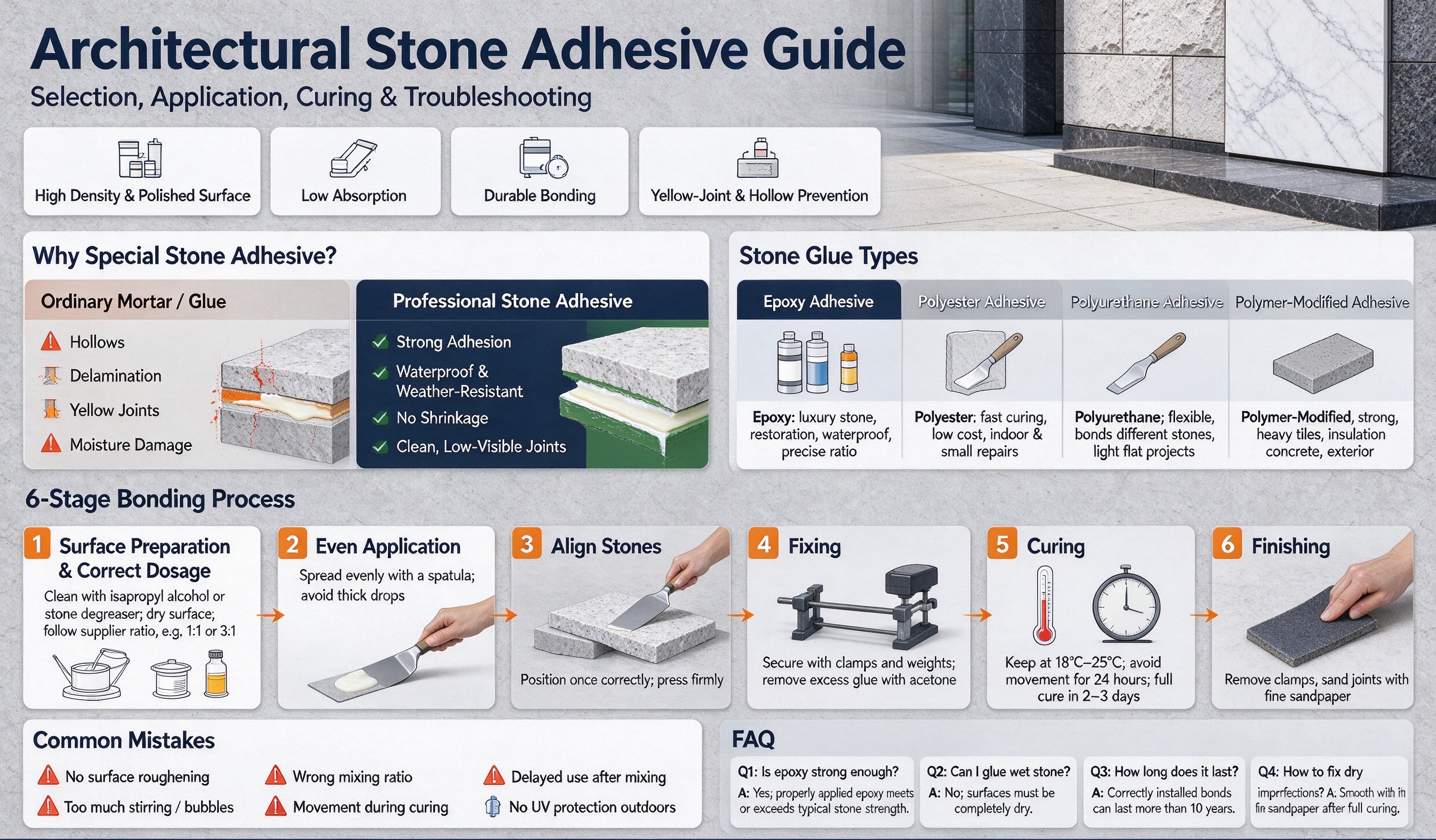
Architectural stone is widely employed as a building material in a variety of applications such as countertops, wall coverings, sidewalks, landscaping projects, and restoration. Architectural stone differs from traditional materials in that it possesses such characteristics as high density, polished surface, and low absorption level and must be selected with care when choosing bonding materials. Usage of stone adhesive for architectural stone is a great choice if you wish to have durable and good-looking bonding, and to avoid many problems that occur when using cheap mortar or ordinary glue like appearance of hollows, delamination of the surface, the appearance of yellow joints, and spoilage by moisture.
This guide provides builders and designers with information about using stone adhesive in order to help them choose a glue for different kinds of architectural stones.
1. The Function of Special Stone Adhesive for Architectural Stone
Cement mortar, and generally, may not work properly while installing any kind of architectural stone of high quality. Most of these types are processed by special polishing technology that enables us to obtain the material with almost no capillary pores and very low sticky properties.Normal glues are not good enough; they wear out and fall apart
in a relatively short period because of temperature fluctuations, moisture, and human activity on construction sites.
It’s also worth mentioning that on top of all that, ordinary glues may leave yellow joints, cracks, and dirt on a stone surface which may spoil the entire look of it. Professional glues for stones, however, have four important features which make them appropriate for architecture and engineering.
1. The first advantage is that they have a high resistance to water and humidity, as well as to any climatic conditions which means that they can be used both inside and outside.
2. The second advantage is that they can be applied to all types of natural and artificial stones.
3. Types of stone glue (pros, cons, and application sphere)
By chemical make-up, today’s market is divided into 4 types of stone glues: epoxy stone glue, polyester stone glue, polyurethane glue, polymer modified glue. Each type can be used for its own purposes in its field helping you to choose the right glue to meet your requirements.
2.1 Epoxy Stone Adhesive (The best option for luxurious architecture)
Epoxy glue which is also known as epoxy is a two-component glue (resin and hardener) which is perfect for repairing and restoration of stones thanks to the fact that it is cross-linked with chemical substances resulting in a very powerful compound.- Main attributes: Strong adhesion because of epoxy resin, does not experience shrinkage upon curing, is completely waterproof, water-resistant, optionally weather-resistant, does not have visible joints, and resists chemicals and high temperature.
– Benefits: Good adhesive strength, no shrinkage during hardening, waterproof and water-tight, and resistant to extreme temperature and chemical effects.
– Drawbacks: The exact proportion must be maintained, slow hardening time.
– Area of application: Outdoor and indoor works with rocks and stones including stone roads and stone installations
– Key features: Low cost and high adhesive ability.
– Pros: Quick drying, affordable, easy to work with, efficient polishing.
– Cons: Limited efficiency against ultraviolet rays and weather environment.
– Area of application: Indoor work with stones and small repairing.
– Key features: The only glue that adapts to different stone materials.
– Pros: Flexible and easy to work with adhesive.
– Cons: Instability of bonding after hardening.
– Applications: Light stone projects with flat stones.
– Applications: For fixing stones on insulation concrete elements of buildings, adhesive attachment of big stone tiles, interior decorations using stones.Application scope: can be utilized for the exterior wall or floor finish in different buildings.
3. Properties of stone glue
Right choice of stone glue provides long-lasting efficiency and nice appearance of the article. The adhesives can be selected according to the type of stone, usage features, and weight capacity.
3.1 Based on the purpose of use.
– For interior use with luxurious design (countertops and interior design): The epoxy adhesives represent the best choice which provides perfect connection for a long period of time.
– For external architecture and gardening: employ only special waterproof epoxy advhensive that is resistant to sunlight.
Big stones or heavy stones require special strong adhesives. When it comes to fragile stones and the bonding process, it is necessary to utilize liquid adhesives in order to avoid staining of the stone.
From the perspective of comparing stone properties.
Heavy polished stones such as granite and marble need special adhesive with good adhesion properties, which necessitates the roughening of the surfaces prior to sticking the material.
Core stones such as travertine and slate require glue with minimum level of shrinking and impermeability to glue.
It is necessary to compare property of man-made stone with polymer-epoxy adhesives used for bonding purposes.
The main features of quality adhesive for construction purposes include non-staining composition, no shrinking process, waterproof ability for outdoor use, excellent adhesion factors compared to the stone, negative temperature tolerance from -20C to +80C and a lifetime of more than ten years.The incorrect procedures in construction will unfortunately render any good adhesive less effective. Nevertheless, there is a method of bonding architectural materiais that has been used successfully and is documented as a six-stage process. The first stage refers to proper surface preparation for bonding.
Adhesive preparation starts with cleaning the surface to be bonded with isopropyl alcohol or a special stone degreaser from dust, grease, wax, and glue residues. Extreme caution is required when selecting the amount of fine sand paper which has to be used for creating micro-scratches and obtaining good mechanical adhesion, and it has to be ensured that the surface remains dry.
Step 1: Correct glue dosage
In epoxy glue usage, it is essential to follow the mixing proportion recommended by the supplier (either 1:1 or 3:1) and to make sure that resin and hardener are mixed in two separate containers in order to avoid contamination. The mixing must be done with continuous stirring until the glue is ready for use.
Step 2: Glue application
The glue must be evenly spread over the surfaces of the stones being joined with the help of a spatula so that the whole surface gets the glue and no thick drops of glue are formed.Step 3 – Aligning the stones and removing the excess glue.
Stones must be put in the correct position and this will be done only once, because moving them again would require repeating the whole process. The stones should be pressed to remove extra glue from their surface.
All of the stones have to be securely fixed in their places with the help of clamps and weights, and the surfaces should be free from glue using acetone.
Step 5 – Curing at uniform temperature.
Once stones are firmly glued to each other it is important to keep them at certain temperature which ranges from 18C to 25C. The bonding of stones usually takes about 2 hours. The bonds should remain untouched for the following 24 hours. The whole process of curing requires 2 to 3 days.
Step 6 – Finishing
As soon as the curing process is accomplished, all clamps and adhesive tape should be taken off and fine sandpaper needs to be applied to smooth the joint.
5. The Most Typical Mistakes Committed in Construction Process Leading to Bonding Problems.
Most bonding-related issues (such as yellow seams, peeling, cracks) occur due to errors made during the process. Here is a list of the most common mistakes to avoidThere is no roughening of the surface: smooth polished stone surface means that it has little bonding effectiveness hence it can easily peel off.
The wrong proportions of glue: Incorrect amount of hardener and resin means that the glue won’t be cured fully.
Too much stirring may lead to a high amount of bubbles in the glue: if there is excessive air in the adhesive, it will not bond properly hence hollowness appears.
Glueing on a wet surface: Water slows down chemical reaction in the glue hence it won’t bond properly.
Start working when the glue has been already mixed: as adhesive cures immediately after mixing, it loses its bonding abilities if used afterward.
Movement while curing: any movement of a stone while curing finishes will break the joint.
No use of paint resistant to UV radiation outdoors: Paints deteriorate when they are exposed to sun and can suffer damage.
Questions and Answers on Adhesives for Architectural Stones
Question 1. Is epoxy adhesive strong enough for architectural stones?
Yes. Performance of standard epoxy adhesive is better than that of natural stones. Correct amount of glue used and precise design of the adhesive provide longer durability against usual loads and temperatures.
Question 2. Can we glue on wet stone?
No. Construction adhesive must be applied on completely dry surfaces. Water takes part in chemical reaction with glue and prevents it from functioning appropriately thus resulting in creation of air bubbles in the glue.
Question 3. How long can construction glue last?
Construction glue does not get destroyed (if made properly). Bond can resist the outer environment for longer than 10 years.
Question 4. How to fix imperfections after glue dries?
One can fix imperfections by using sandpaper to make the glue smooth after it has dried.

