
Stone adhesive that fills gaps

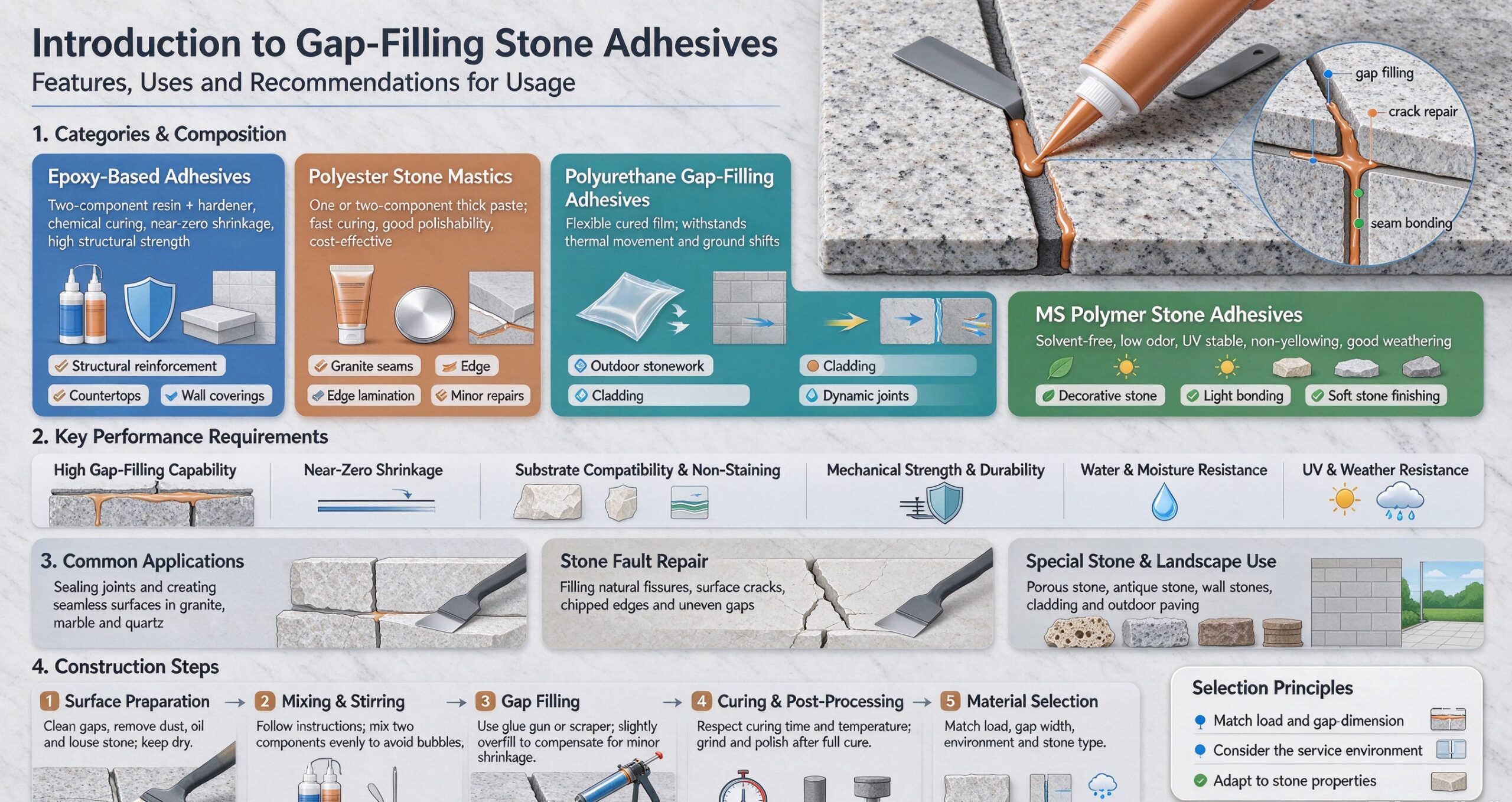
Introduction to Gap-Filling Stone Adhesives: Features, Uses and Recommendations for Usage
Gap-filling stone adhesive is a type of construction material that has the unique properties of filling gaps between stones, closing seams, repairing cracks, and making a bond between any natural stone or artificial substrate. Gap-filling stone adhesives differ from ordinary adhesives as their functions do not simply connect two surfaces; these adhesives have a unique formulation that allows these adhesives to fill all kinds of gaps, from minor to wider ones with a high viscosity and solidity of the final product. They have spread in the process of installation and restoration of stones such as granite, marble, quartz, travertine, and sandstone.
1. Categories and Composition of Gap-Filling Stone Adhesives
Based on chemical composition, method of curing, and the ability to fill the gaps, one can classify gap-filling stone adhesives into four basic types, each with its advantages and applications.
1.1 Epoxy-Based Adhesives
Two-component epoxy adhesive is one of the most popular gap-filling stone adhesives that is widely used in high-end applications. It consists of two parts – resin and hardener, which cure due to chemical crossing. After the curing, it features almost zero shrinkage. With the help of its high-thixotropic nature, epoxy adhesive can fill various kinds of gaps, including cracks, seams, or uneven voids even on a vertical surface. After curing, epoxy adhesive displays high bonding strength, good resistance to compression and tension, and excellent waterproofing. It can be used in various applications for structural reinforcement as well as permanent filling of bearing stone elements (e.g., countertops, wall coverings, and floor slabs).1.2 Polyester Stone Mastics
Polyester mastic is thick-paste adhesive which can be either one or two-component and is referred to as the “workhorse of conventional stone work”. Due to having moderate viscosity and rapidly curing, polyester mastics fill tiny cracks and gaps in stone slabs very effectively. Compared to epoxy, the advantages of polyester mastics are lower prices, less complicated technology of use, and better polishability. This makes it possible to grind and polish the stone slab after the adhesive has cured. Polyester mastics are frequently utilized in stonework with mass production of stone products, including granite seam filling, edge lamination, and minor repair works. This adhesive has the disadvantage of slightly lower strength and resistance to weathering compared to epoxies, which makes it applicable only for indoor non-load-bearing constructions.
1.3 Polyurethane gap filling adhesives
Polyurethane stone adhesives are needed because of flexible gap-filling materials that need to withstand dynamic environmental conditions. The cured film possesses necessary elasticity and toughness that enables it to deal with deformation of stone substrates due to temperature changes and ground shifts. Thanks to the aforementioned characteristics, cracking and unadhesion of stone surfaces can be avoided. Polyurethane adhesives are capable of performing well in terms of water and moisture resistance and low-temperature curing.
1.4 MS polymer stone adhesives
MS – modifier silane polymer adhesive is eco-friendly and solvent-free adhesive with corresponding performance properties. The advantages of these adhesives are low smell, absence of yellow spotsWith an average gap-filling performance level, excellent UV resistance, and ability to weather well, they are recommended for high-quality decorative stones, light bonding purposes of the block materials and delicate finishing of traditional and soft stone types.
2. Performance Requirements for Quality Stone Adhesives
Quality gap-filling stone adhesives must comply with strict market requirements in order to ensure the quality of installation. The primary technical characteristics are as follows:
High Gap Filling Capability: The adhesive is supposed to provide consistent suspension and filling capabilities regardless of the gaps’ width, which may vary from 0.1 mm to 10 mm. Its high-thixotropic properties prevent sagging and dripping during vertical and overhead applications, thus ensuring the complete and even filling of uneven stone gaps.
Zero Shrinkage and Dimensional Stability: The low curing shrinkage is one of the major properties of the gap-filling stone adhesive that guarantees the absence of re-cracking and surface unevenness. High-quality products provide almost zero volume changes after curing, thus ensuring a stable flatness of the gap-filling surface.
Substrate Compatibility and No Staining: The adhesive must be compatible with various stone densities and porosities, thus avoiding penetration, pollution, and yellowing of light-colored porous stone (including such types as marble or travertine).
Mechanical Strength and Durability: The adhesive must be able to withstand any physical influence that the stones may be exposed to under ordinary circumstances in their service life.Environmental and Weather Resistance: Premium products commonly offer attributes which allow them to be waterproof and moisture proof, resistant to UV rays as well as temperature changes. Formulas meant for outdoors can withstand severe weather conditions including extreme heat, freezing weather, and erosion from rain which may harm the products otherwise.
Types of its Use:
Various kinds of filler adhesives are used according to the type of project and the characteristics of the stone, covering the most common scenarios in stone engineering:
Stone Slab Jointing: Used for the sealing of joints and seamless joining of slabs of granite, marble, and quartz. Colored epoxy fillers are widely used in high-end decoration requiring the joints to be invisible and create a seamless surface of stone.
Stone Fault Repair: Used for the filling of natural fissures, surface cracks, chipped edges, and gaps. Regular stains use polyester mastic for repairs, while high-strength epoxy adhesives are used for deep cracks and restoration of damaged structures.
Choosing the Right Type: For paving, filling and fastening of landscape stones, wall stones, and cladding. Polyurethanes and MS polymers are adopted for use outdoors with a possibility of heat fluctuations and minor movements in construction.
Specifics of Use in Special Stone: Gap filling for soft and antique stones, as well as porous decorative stones, is accomplished with no staining and it is taken care of by specialConventional construction process
Synchronized construction processes are important for improving the performance of gap-filling stone adhesive materials. In particular, there are four critical steps involved in the overall construction results.
1) Pre-processing of a surface: The process relies on proper cleaning of the stone gaps and adjacent surfaces to remove any dust, oil stains, old glue residues, and loose pieces of stone. It is important to guarantee that the insides of the gaps are dry, clean, and free from any contaminants in order for the adhesive to be effective. In situations when the gaps are wet, it is critical to cure them completely or use moisture-resistant glue products.
2) Mixing and stirring of adhesive: Two-component products must be prepared strictly in accordance with the instructions. Mixing of two components must be performed correctly in order to avoid bubble formation. If the components are not mixed sufficiently, there will be uneven construction and low adhesive strength, while many bubbles will lead to blank areas.
3) Filling the gap: The gap itself should be filled with glue using a glue gun or a scraper. Make sure to slightly overfill the gap at the moment of construction in order to compensate for the eventual minor shrinkage that will happen afterward (during the curing process).
4) Curing and post-processing: Initiate your construction activities following the recommendations regarding the curing temperature and time. After the full curing of the adhesive materials, grinding and polishing of the filling surface should also be performed.
5) Properly selecting the materials
Adequate adhesive choice is a crucial factor determining quality and lifetime of a project. The selection implies three core principles:
1) It is necessary to correlate the load that the stone structure has to bear with the gap dimension.
2) The construction implies taking into account the environment where it will happen.
3) The selection depends on the properties of the materials that will be used.
6) Conclusion
Gap-filling stones have a key role in stone engineering because they are an important element in determining the quality, aesthetic value, and durability of stone constructions. The gap-filling stones that are used for stone engineering today are mainly distinguished for high strength durability and environmental protection, zero stain capability, and color flexibility. Therefore, the professionals working with stone architecture should know about the classification of gap-filling adhesive materials, their properties, application uses and construction methods used to guarantee successful achievement of high-quality results in stone projects and provide stable outcomes afterward.

