
Epoxy glue suitable for stone restoration

Ultimate Epoxy Adhesives for Stone Repair.
The process of stone repair employs strong and resilient adhesive solutions, which can make undesired materials disappear when bridging cracks, joints, edges, and loose pieces of stone of marble, granite, travertine, limestone, quartz, and other artificial stones. Comparing the options that can be used, epoxy adhesive for stone repair remains the number choice technologically and in terms of durability and its quality as an adhesive. This guide describes the reasons why epoxy is the most suitable material for stone repair, main factors that should be taken into account when choosing glue, various types of epoxies that suit your needs, how to apply glue successfully as well as different tips on preventing the mistakes made by semi-professionals.
Benefits of Using Epoxy Adhesives for Stone Repair
Unlike other adhesives such as super glue or polyester or cement based glue, epoxy was produced by following relevant requirements concerning physical and chemical characteristics of stone used in nature as well as stone production.
– High Strength of Bonding: Two-component epoxy adhesive sticks strongly to both surfaces forming a solid connection, which can withstand a tensile strength of between 3,500 and 5,000 PSI. It is good for holding heavy stones in place and repairing damaged edges caused to stone surfaces.
– Superb Moisture and Water Resistance: Epoxy glueEpoxy is resistant to dissolving, swelling, and delaminating in damp areas and environments, which positions it as the ideal adhesive for use in stone restoration for stone used in bathroom countertops, outdoor statues and tiles, patio tiles, and stone parts of water fountains.- Invisible aspect and aesthetics: High-grade stone restoration epoxy is cured to achieve full transparency and perfect color match without any yellowish tinge and visible seams. In addition to this, the epoxy is able to fill the stone pores and enable seamless repair that is making it possible to sand, polish, and cure it to create the finish similar to its original one.
– Weather and chemical resistance: High quality epoxies have a significant resistance to UV rays, temperature fluctuations, and small amounts of chemicals. This also prevents fading and makes the structure resistant to brittleness and changes in color related to prolonged exposure to sunlight.
– Compatibility with different types of stones: The epoxy is suitable for every kind of stone, whether it is a stone with a soft construction (marble, travertine, limestone) or stone with a hard construction (granite, quartzite, basalt) as well as man-made quartz and engineered stones.
The main aspects of choosing epoxy to restore stones.
It should be noted that glue is not effective for use in the restoration of stone. If one uses the standard epoxy, he/she risks ruining the stone and causing its staining. In this regard, high-grade stone restoration epoxy must meet several essential requirements.
1. Stone-safe.
Calcium-based stones (marble, travertine, limestone) are very susceptible to acids. This is why it is always necessary to pay attention to using acid-free epoxy in stone restoration.Acidic adhesive products will damage the surface of the stone by making it look dull, resulting in weak bonding. Professional stone adhesive consists of neutral components that keep the stone intact.
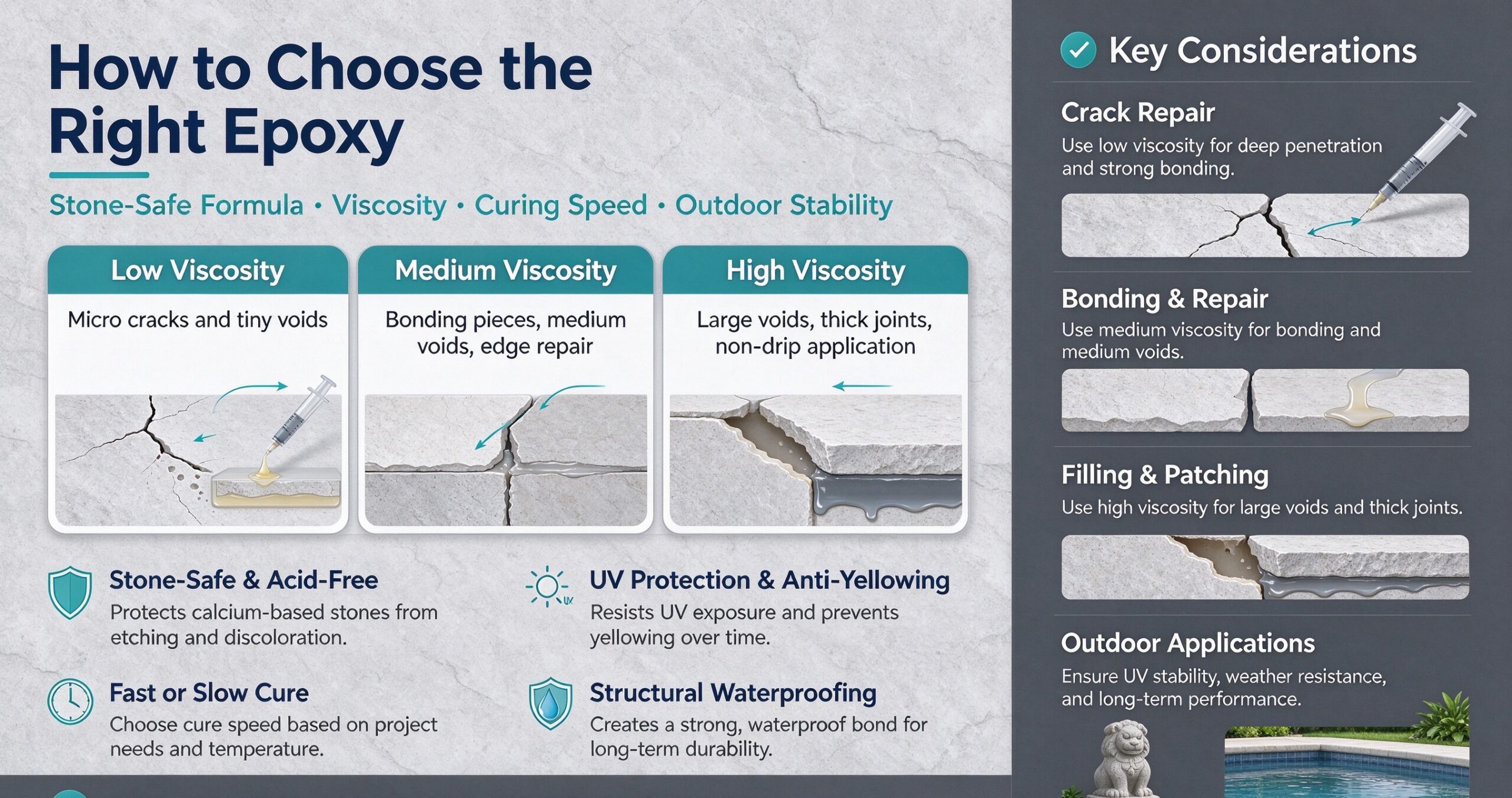
2. Proper viscosity of epoxy for different situations
The viscosity of the adhesive determines its efficiency when it comes to repair processes. Use the viscosity that suits the necessary restoration.
– Low viscosity adhesive: It is preferable for sealing very small cracks and tiny voids as it fits properly into microscopic voids in the stone and strengthens the structure inside while not holding air bubbles.
– Medium viscosity adhesive: This adhesive may be used while fixing stones in various ways, such as for bonding two pieces of stones together, filling in voids of medium size, and repairing edges as it gives the best filling and flowing performance.
– High viscosity adhesive: This adhesive is used for sealing large voids and cracks and for connecting the stones that must be glued together. This type of adhesive does not drip while being applied on its end.
3. Protection from UV rays
When doing repairs for indoor or outdoor stone décor make use of UV-proof and anti-yellowing adhesives.Specialized epoxies utilized by professionals are mixed with special ingredients that ensure that the light filters are preserved for a long time.
Adjustable time for curing
Depending upon the type of job being done, there is an option of fast curing epoxy (10-30 minutes) used in urgent cases or slow curing epoxies taking 2-6 hours.
Best types ofIntegrating mineral pigments with transparent epoxy resin allows us to achieve color mix for repairs without leaving a visible mark on the surface.
4. Stone Restoration in Open Air and Wet Conditions
For outdoor stone sculptures, patio stonework, and swimming pool edges, one needs a structural waterproof epoxy glue. Paradoxical properties of the material make it completely impervious to moisture, mold and mildew, as well as to breakage.
Right Technology of the Effect Achieving
The first thing one should do is Dust Removal and Degreasing: Blow dust using compressed air and clean the repair area with acetone until it is completely dry and free from grease.
3. Mixing Epoxy Resin: Carefully mix the two-component epoxy resin (components A and B) according to the instructions strictly observing the proportions of components. Also, stir the mixture for 2-3 minutes to prevent the results from being inconsistent because of improper mixing. Make sure to clean the sides of the container.
4. Bonding and Application: Apply the mixture evenly onto the surface of the components to be bonded or fill the gaps and cracks in the surface. Be especially careful with the alignment of parts and clamp them tightly in order to prevent moisture from getting inside.
5. Curing in Constant Temperature: Maintain a stable temperature of the glued stone of 65-85 °F (18Do not forget to eliminate low temperature, high humidity and direct keeping light because it may harm the curing process and lead to defects on the surface. You have to wait for the curing process to be finished according to the manufacturer before proceeding with any further processing.
6. Finishing and Polishing: After the curing process has come to an end, it is a good idea to wipe the excess epoxy by means of a knife or possibly fine sandpaper. You have to remember to polish the area gradually so that the original look and smoothness of the surface will remain intact.- Improper preparation of the surface. Residual oil, dust or wax will hinder in the making of the bond between the stone and epoxy which would make it impossible to stick to it and thus it will be peeled off easily.
– Wrong choice of epoxy viscosity. High viscosity epoxy is not able to penetrate, whereas low viscosity epoxy will not fill the cracks properly and will make the repair useless.- Not allowing for enough curing time. Using epoxy too soon and polishing it improperly will lead to a poor bond and possibly many cracks.
– Too much pigmentation of the epoxy leads to destruction of the bond and local discoloring of the stone.
Conclusion
Professional epoxy glue is the epoxy adhesive which is the best one currently available to be used for restoration since this glue is durable, strong and looks good. Epoxy should be suitable for the type of stone being repaired and this glue should be used according to the instructions needed to be followed for the construction.
FAQs on Epoxy Glue for Stone Restoration
1. Is it safe to use epoxy glue to restore marble?
Yes, provided that acid-free epoxy is being used. Acid-containing adhesives should not be used for the restoration of marble since they ruin the surface of the stone, while neutral epoxy is absolutely safe for marble, travertine, etc.
2. How long will the restoration last?
Good quality UV resistant epoxy restoration last for 10-20 years if proper methods of construction and materials are used.
3. Is it possible to polish cured epoxy to make it look like the stone?
Yes, cured epoxy has hardness similar to that of natural stone and thus it can be sanded and polished.
4. Will epoxy glue turn yellow?
Common epoxy glues turn yellow over a period of time, while premium anti-yellowing and UV-protected epoxy glues are able to maintain clarity for a prolonged period of time.

