
Stone bonding glue crack resistant

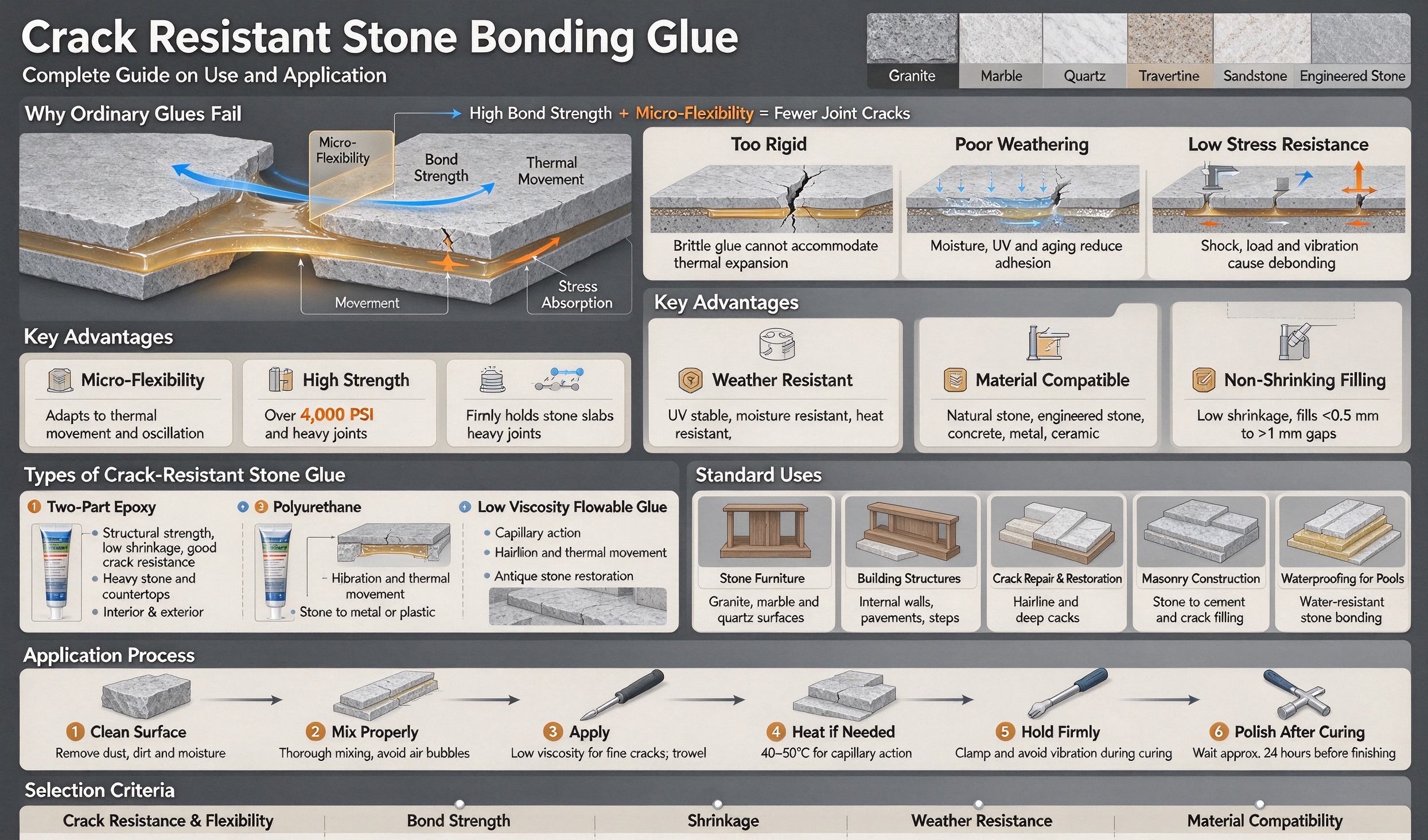
Crack Resistant Stone Bonding Glue: Complete Guide on Use and Application
When dealing with natural stone, engineered stone, masonry, and stone restorations, you will realize that crack resistant stone bonding glue is one of the most critical products that guarantee you high-quality results. All types of conventional stone adhesives tend to fail with time, creating cracks in the joints, fissures on the surface, bond separation, and damage to the stone due to fluctuations in temperature, vibrations, and loads. However, crack resistant stone bonding glue is an industrial-grade product made specifically to deal with such problems and provide the required strength combined with the necessary level of flexibility of the adhesive for any stone jobs done indoors or outdoors.
This Guide will discuss everything about crack resistant stone bonding glue such as its specifications, functioning, types, areas of application, tips on choosing glue, and its application process. The article is written in a simple way so everyone, whether a novice or a professional, will be able to select and use the required adhesive for stone bonding.
What is a Crack Resistant Stone Bonding Glue?
Crack resistant stone bonding glue is a type of a structural adhesive for stone bonding and repair that provides highest performance. This type of glue differs from a common building glue that produces rigid and stiff bonds because during the production process its makeup is such that this glue combines high bonding strength with micro flexibilities.The glue that is crack-proof has the capability of keeping the minor structural motions, heat expansion and contraction and force that is applied in order to minimize the various cracking issues like seam cracking, hairline cracking and cracks due to peel off. The glue works perfectly on all types of stones like granite, marble, quartz, travertine, sandstone and man-made stone materials.
Cracking Reasons
In order to appreciate what crack-resistant stone adhesive can do, it’s important to know why the other bonding materials fail. Usually, the cheap stone glues fail because of the following three:
1. Too Stiff After Being Cured
The commonest stone glues are cured into hard and stiff glue layer. The stones are expanded when we heat them and this stiff glue can’t take those minor changes into account, thus creating tension in the glue and cracking the joints.
2. Bad Resistance to Weather and Aging
Regular glue does not tolerate bad weather conditions when being wet and kept outdoors for a long time. The glues lose their viscosity and shrink if kept outdoors due to aging.
3. Improper Resistance to Stress
Stone surfaces and products constantly bear weight and sometimes can experience shock during their operation. This is why common glue does not give the necessary tensile strength and causes cracks in the course of time.
Pros of Using Crack Resistant Stone Bonding Adhesive
To solve the mentioned issues, the special crack free stone adhesive has been designed to provide a lot of benefits in the stone processing.
1. Great Flexibility
Great adhesive has certain flexibility after its curing process so that it can adapt to thermal expansion and oscillation.
2. Very High Strength
Super glue has binding strength of over 4000 PSI, which is really much higher than regular glues. As a result, it is able to firmly hold the slabs of stone without forming holes, being displaced, or coming off. This means that it is suitable for jointing and filling heavy stone places together.
3. Great Weather Resistance and Aging
The best products possess UV resistance, moisture resistance, and heat resistant properties. They do not become yellow and do not shrink or crack under conditions of sun rays, rains, and extreme temperatures.
4. Compatibility with Various Materials
It can be used together with all kinds of natural stones and synthetic stones, as well as, in some cases, to glue stones with concrete, metals, and ceramics. Moreover, it solves the problem of cracking due to different thermal expansions of the materials.
5. Non-Shrinking and Seamless Filling
Low shrinkage curing technology guarantees that micro-gaps will not form after the curing process is over. It is able to fill cracks with the width of less than 0.5 mm as well as large gaps over 1 mm.Categories of Stone Bonding Adhesives with Crack Resistance
There are three main kinds of stone bonding adhesives that can keep away crack problems, and each of them is appropriate to definite situations:
1. Two-Part Epoxy Stone Glue
Epoxy based stone adhesive is the most well-known type of crack resistant adhesive for stones. It is incredibly strong (structurally speaking), doesn’t shrink much, and has good resistance to cracking. The adhesive is quite hard, meaning that it guarantees reliable support and has a bit of flexibility that keeps the adhesive from cracking. Indeed, it is applicable for heavy stones as well as in the cases of connecting different sections of the countertop. Moreover, it is resistant to moisture and solvents, which means that it can be applied both for the interior work and outside.
2. Polyurethane Stone Bonding Adhesive
Polyurethane adhesives are very flexible and can withstand dynamic loads. They have a much higher degree of flexibility as compared to epoxy glue, which is perfect for the cases involving vibrating stones or temperature changes. They are a perfect option for the cases of gluing stone to metal and stone to plastic because the glue will not crack due to differing expansion rates.
3. Low Viscosity Flowable Glue
This low-viscosity glue is produced mainly for repairing hairline cracks in stone. Due to its great ability to “climb,” this glue can penetrate into any crack or gap in the material.Repairs on cracked stones or restoration of antique stone items make use of the material.
Standard Uses of Crack Resistant Stone Bonding Adhesives
The Adhesive can be used in home as well as public works such as:
1. Installation of stone furniture: Gluing of granite, marble and quartz surfaces and avoids seams from cracking.
2. Building structures: Use for internal stone walls, pavements outdoor stone steps and walls.
3. Crack repairing and restoration: For hairline and deep cracks on antique stones.
4. Stonework in construction: Connect stones to cement and fill cracks in masonry construction.
5. Any other special cases: Waterproofing a stone for pools.
Cleaning of Stone Surface
To clean stone surface properly, it is important to remove any debris from its surface. The surface must also be clean, dry and smooth. Any impurities can cause problems in adhesive performance since they reduce the bonding strength.
Glue Mixing Process (2 component glue)
Glue proportioning is very important for proper adhesive mixing. It is necessary to mix it thoroughly to avoid any air bubbles. Not mixing the glue properly will lead to uneven curing conditions.
Application
For small cracks less than 0.5 mm use low viscosity glue by capillary action and heat the surface at 40-50 degrees Celsius. In case of larger cracks, viscous glue must be applied using a spatula and tightly pushed.
Fixation Required After Application
Once the glue is applied onto the stone, it is necessary to keep it firmly in place to prevent movement during the curing process. No vibrations must be allowed during the curing process.
Post Curing Polishing
After the curing of glue (around 24 hours later), polishing of stone surface must be performed to remove any excess glue.
Survey of Criteria in Choosing Good Stone Glue
In order to choose right adhesive, it is necessary to follow the guidelines below:
1.Crack resistance and flexibility – choose glue with micro-elasticity instead of rigid one.
2.Bonding strength – it is better to use adhesive with above 400 psi tensile strength.
3.Shrinkage – it is advisable to choose glue with no or minimal contraction as otherwise microcracking may occur.
4.Weather resistance – select glue that is UV stable and waterproof.
Summary
Cracking and debonding are persistent problems associated with stone installation and maintenance. Using resin is the most economical way to make stone projects stable and efficient.

