
Epoxy for stone structural repair

Epoxy for Stone Structural Repair: All You Need to Know from Professional Point of View
Keywords: epoxy for stone structural repair, stone crack epoxy injection, structural stone repair epoxy, high strength stone bonding epoxy, natural stone structural repair products
Any stone structure with materials such as granite, marble, limestone, sandstone, or engineered stone can develop cracks, fissures, voids, or loosened joints that can be caused by aging, earthquakes, weather conditions, heavy loads, or improper installation. Epoxy is by far the best material for stone structural repair due to its strength as a restoration material. It is a great way to remedy the structural integrity of stone surfaces as well as restore damaged stones and thus extend the lifetime of architectural stone features. Structural epoxy differs from ordinary sealants and adhesives by providing solid waterproof as well as weight bearing bond between stones, thus eliminating any hidden structural issue.
1. Why Structural Epoxy Is the Best Solution to Stone Repair
As natural stone is porous and fragile, regular repair materials cannot solve structural issues. Structural epoxy has been developed specifically to meet stone characteristics and has many advantages over cement, polyester resin and other adhesives.
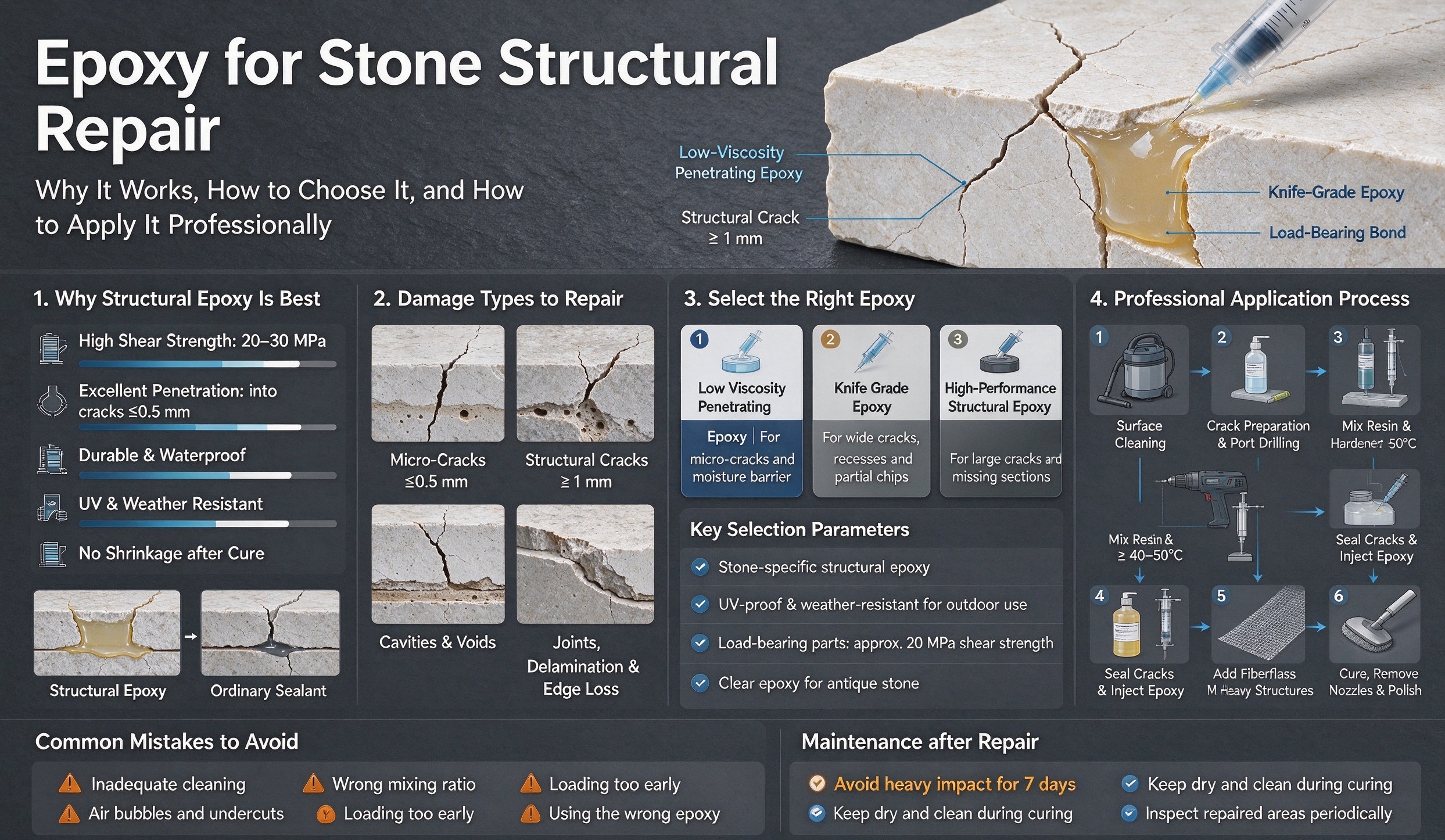
– High Structural Strength: Once cured, structural epoxy has a shear strength of 20-30 MPa that is good enough to withstand any static or kinetic load acting on stone materials. It does not only fill visible chinks but also micro-cracks in the stone.
– Long-Lasting Quality: Structural epoxy has a much better durability compared- Outstanding Penetration and Flexibility: Low-viscosity epoxy resin demonstrates high capillarity and can be poured into cracks that measure 0.5 millimeters or less in width. On the other hand, the thick knife-grade epoxy makes filling wide cracks and holes possible, thus providing no shrinkage.
– Resistance due to the environmental factors: After final curing, epoxy does not get affected by water, ultraviolet rays, temperature variations, any chemical impact, and freezing/thawing cycles. As a result, it prevents opening existing cracks on the stones formed due to moisture and atmospheric aging thus suitable for use in both outdoor and indoor stone installations.
– No shrinkage and high durability: In contrast to resins based on solvents, which shrink during the curing process, two-component structural epoxy is polymerized through a chemical curing process and does not have shrinkage thus ensuring the durability of the structures.
– Aesthetic compatibility: Both clear and colored epoxy formulations are able to preserve the original texture and color of a surface as they only enhance the gloss and smoothness of the texture of the stone.
2. Kinds of stone structural damage suitable for epoxy repair
The scope of structural epoxy usage is virtually limitless, covering all varieties of natural and man-made stone since the material can be applied to repair stones for facades of buildings and stone furniture items such as countertops and Stone paving as well as restoring antique stone.
– Very fine cracks: The tiniest invisible cracks caused by temperature changes that become larger as a result of moisture penetration.Low viscous penetrating epoxy penetrates all micro-cracks and preserves repair against degradation.
– Structural cracks (≥1 mm): These are the cracks causing structural issue due to foundations one way or another. Thick knife-grade epoxy fills and supports structural cracks effectively reinforcing the material strength.
– Cavity defects: Here we mean any void space inside slabs of stone.
– Separation of joints of stone splices and layered delamination of thin slaps of stone. Strong epoxy bonds assemblies of stone and strengthens laminated structures.
– Damaged edges/corners or lost/crumbled parts of stone. Epoxy will repair stone properties completely.
3. How to Select Proper Structural Epoxy to Repair Stones
Improper selection of epoxy is the main reason of failing the repair. Specifics of structural repair are in a wide variety of situations when one will need to select epoxy based on the crack width, the kind of defect and environmental conditions.
3.1 Low Viscosity Penetrating Epoxy
As stated above, it is necessary for micro-fractures (width ≤0.5 mm) and strengthening of micro-fractures since it penetrates inside stone by capillarity and serves as an obstacle for moisture coming into the material because of its very low viscosity.
3.2 Knife Grade Epoxy
This type of epoxy is the best solution for wide cracks (width ≥1 mm) and for stones with surface recesses, as well as partially chipped ones.3.3 The High-Performance Epoxy
This type is perfect in the restoration of sizeable cracks found in stone structures and also missing sections of the stone structure.
3.4 Parameters for Selection
– Choose stone-specific structural epoxy instead of using general adhesives in order to prevent the breaching of the stone.
– Make sure that stone projects meant for outdoor applications should have UV-proof and weatherproof formulas to avoid the yellowing process of the epoxy.
– Load-bearing parts should use epoxy that has shear strength of about 20 MPa.
– Use transparent epoxy when working on antique stone material.
4. The Professional Stone Structure Repair
Standard construction processes ensure that repairs made to the stone structure will last for a long time. Below is the process that will be used to restore a stone structure.
Step one: General cleaning of the surface.
With the help of a solid cleaning agent and brushes, you should remove dust, dirt, sealant, etc. Afterwards, you should blow out the cracks and clean their openings. At the final stage you should eliminate any oil and dirt using acetone.
Step two: Pre-treating of the cracks and voids.
If the crack is open, appropriate cutting should be provided to remove delicate stone. Depending on the type of the crack, the holes should be created for the injection ports.Phase 3: Resin Mixing
Structural epoxy requires the mixing of two components: epoxy resin and hardener. The temperature should be kept at the level of 40 to 50 degrees Celsius for the mixture and the process of mixing should take place away from the cold environment.
Phase 4: Sealing the cracks and injecting epoxy
For minor cracks: a low viscosity epoxy should be applied over the crack. For larger cracks: scrape the epoxy over the crack and push it down resulting in the air being released from the crack. For deeper cracks: inject epoxy using multiple ports in a row.
Phase 5: Additional reinforcement (optional)
For a bigger structure with substantial weight, a fiberglass mesh might be necessary to be added over the applied epoxy.
Phase 6: Complete curing and finishing processes
After the curing time has passed, injection nozzles should be removed and the surface of the repaired stone structure should be polished until it is completely smooth.
Common Mistakes to Avoid During Stone Epoxy Structural Repair
– Inadequate cleaning of the surfaces. Surfaces cleaned from contamination will not allow epoxy to adhere properly thus resulting in peeling and opening cracks.
– Wrong mixing proportions of the components. Improper mixing will lead to incomplete curing of epoxy.
– Usable construction technique. Undercuts and bubbles created will jeopardize the strength of the structure.
– Using load-bearing structures too early. This will lead to secondary damage of the uncured epoxy.
– Applying wrong epoxy. Dissolvable decorative epoxy would not meet structural requirements.
6. Recommendations for Maintaining Stone Structures that Have Been Repaired
High-quality repair of stone surfaces may last for decades provided that certain rules are followed. The first rule is to refrain from heavy impact for a week.
7. Conclusion
Using epoxy for stone structural repairs is an economical way to repair any kind of damage. High penetration ability and bonding strength, lack of shrinkage and high weather resistance make it an efficient method to restore load-bearing capacity of stone structures and preserve the beauty of the stones.

