
Best epoxy for outdoor stone repair

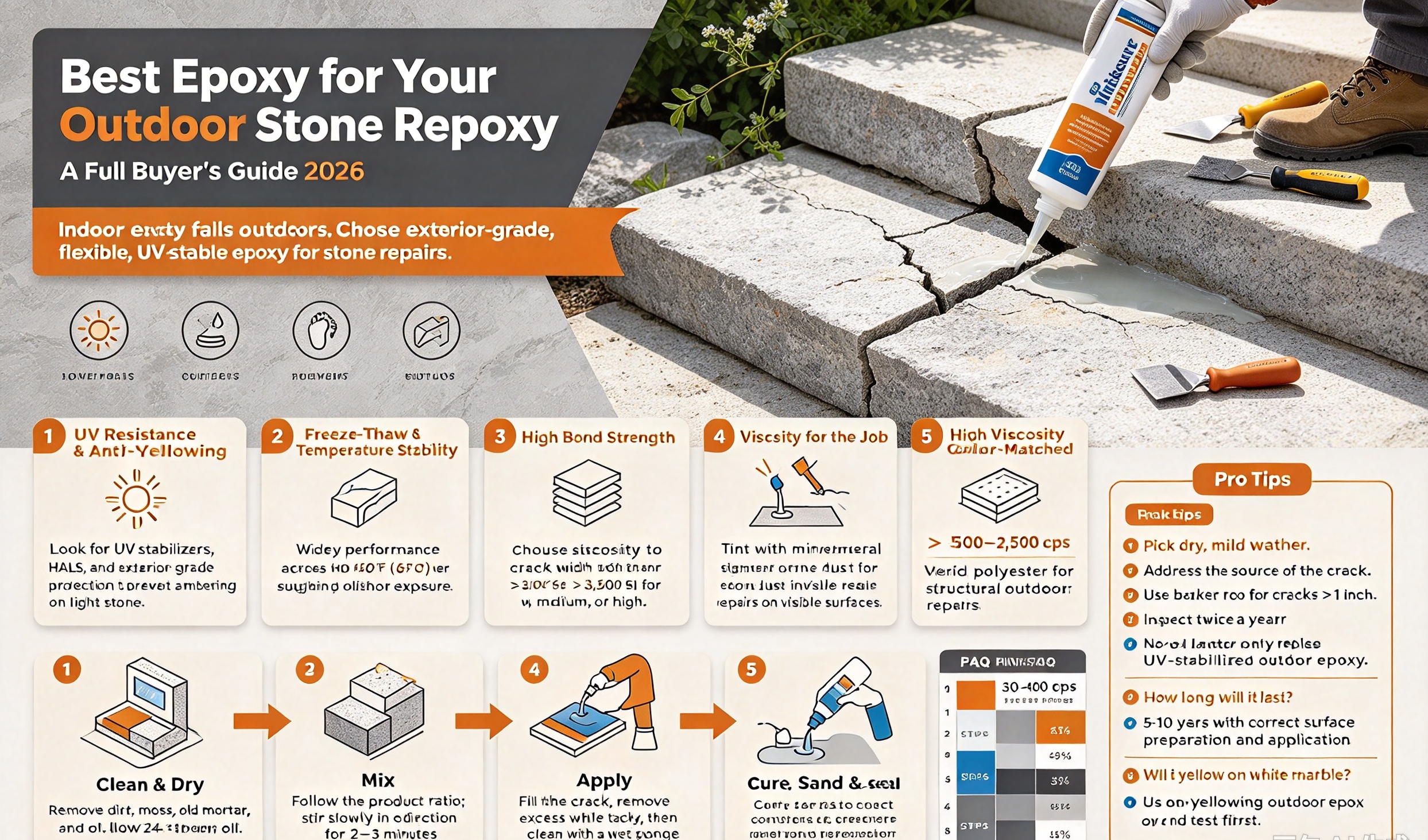
Best Epoxy for Your Outdoor Stone Repairs: A Full Buyer’s Guide 2026
The article “Best Epoxy for Outdoor Stone Repairs: Full Buyer’s Guide” is written in accordance with the principles explaining what the best outdoor stone epoxies should be like. Outdoor stone structures such as granite steps and marble pavers face extreme temperature changes from the sun, rain, snow, humidity, foot traffic, and thermal activities. Indoor epoxy formulas will not work outdoors because common epoxy solutions become brittle in the winter, start chalking in the sun, and will peel off during wet-dry cycles.Choosing the right epoxy outdoor stone repair will make the difference between the time the repair will last after completion—five years or five months.
What to Look for When Choosing Epoxy Productsolulu
Ordinary epoxies are made for indoor environment, where humidity, temperature, and lighting are controlled. Ordinary epoxies can’t overcome the four main threats that outdoor stone repair has to deal with:
– Extreme temperatures. The temperature of 140°F (60°C) in summer, followed by one below the freezing point of water requires tremendous movements and expansion, which are beyond the capabilities of common indoor epoxy products.
Outdoor epoxies can stand these challenges due to UV stabilizers, flexible hardeners, and cross-linking polymer chemistry that allows to keep the bond from around -20°F to 150°F (around -30° to 65°C).Five Essential Attributes of Quality Outdoor Stone Epoxy
There are five essential characteristics to take into consideration when selecting the most suitable epoxy for the repair of outdoor stone. The list of important traits will be useful in the process of the selection of epoxies intended for granite, marble, limestone, sandstone, travertine, as well as different kinds of artificial stones.
1. UV Resistance and Anti-Yellowing
If the manufacturer states that the device is “UV resistant”, “weatherable”, or “exterior grade”, it means that it constitutes the appropriate outdoor stone epoxies containing HALS and UV absorbers preventing the product from acquiring an amber tone which is detrimental for the repairs of light stones like Carrara marble. When it comes to the outdoor surfaces, it is of great importance.
2. Resistance to Freeze and Thaw and Resistance to Temperature
Be sure to look through the technical characteristics of the chosen product to verify whether it can work properly in the temperature ranges you are interested in. A good outdoor product should work properly from -40°F (-40°C) to 150°F (65°C).
3. High Bond Strength (PSI Rating)
Most epoxies will have a shear strength of around 3,000 PSI (20 MPa). In case of a load-bearing repairing, such as stair tread or structural cracks, it is advisable to find a product possessing over 3,500 PSI rating. The adhesive should be stronger than the stone material, meaning that the stone should be broken prior to that.
4. Different Viscosity for Different Repairs
The viscosity of the epoxy will determine how the product will behave after it has been applied.There are three main varieties of viscosity, and whenever one is not choosing the appropriate viscosity for the specific purpose, people are likely to make a mistake.
Viscosity Type
Characteristics
Best Suited For
Low viscosity (30–400 cps)
Very liquid-like and watery
For hairline cracks and fissures. Provides great penetrating ability into narrow spaces.
Medium viscosity (500–2,500 cps)
Thick and able to be poured.
For more standard fillings and wider cracks.
High viscosity (more than 3,000 cps)
Putty-like.
Doing vertical sides, cracked corners, reoiling nosings.
5. The presence of tintable or color-matching feature
The issue with transparent epoxy is that it looks absolutely different when applied to dark stone surfaces in terms of appearance. When doing hidden repairs, such as for steps and porches, it is better to use a colored epoxy with stone pigments included in its composition.
The best epoxy types for specific repairs
There is not one universal solution since a lot depends on the situation. Here are the types to use epoxy for.
Outdoor epoxy – most suitable for outdoor jobs. It is represented by 1:1 epoxy mixture which guarantees 15–25 minutes of working time and 24 hours of curing time. Moderate viscosity is the best formula for DIY projects.
Knife-Grade Epoxy – for vertical edges and corners
In case of replacing broken edges or vertical surfaces, the epoxy would run off with the first touch. Knife-grade epoxy (also known as non-running or structural putty) isLow-viscosity epoxy- fine fissures
The problem of utilizing an epoxy that is too thick arises with fine fissures. Low-viscosity (injection-grade) epoxy penetrates through the cracks completely on its own, as does penetrating sealer. It can be used to repair fissures in marble or limestone outdoors to prevent serious damage of material.
Tintable epoxy rendering repairs invisible
If the repair is done at a very visible site (such as front stairs or facade), tintable epoxy gives you an opportunity to match the color with that of the stone material. You may add mineral pigments or fine stone dust obtained from sanding the stone.
Guidelines for fixing outdoor stone with epoxy
Even the most high-quality epoxy will get contaminated if the surface has not been cleaned properly. To ensure your repair is successful, adhere to the following methods:
1. Clean the surface thoroughly. Use a wire brush to eliminate dirt and moss and any old mortar. In case there is some tough dirt, use a low-pressure washer and let the surface dry for 24-48 hours. Remove oil and any other dirt using acetone or denatured alcohol.
2. Widen hairline cracks. To widen hairline fissures, use a diamond blade and angle grinder to scribe a V-groove (about 1/8 inch in width) in the case of hairline fractures narrower than one inch.This means that the epoxy has a wider area to act on and it also assures that the crack will not move through the filler.
3. Roughen smooth edges. If you are trying to glue two parts or repair a chip on the polished stone, just scratch the surface lightly with sandpaper.
4. Prepare the epoxy. Mix it according to the instructions of the manufacturer, mostly in the ratio of 1:1. Stir slowly in one direction for 2-3 minutes before mixing it with stone powder or an additional color.
5. Apply the epoxy into the crack. You should apply the epoxy into the crack/chip with the help of a putty knife leaving the surface not completely flat. Scrape away the excess material while it is still sticky. Wait for about 10-15 minutes or until it becomes gel-like and scrape off the excess with a razor blade. Clean the surface using a wet sponge.
7. Cure the repair completely. Weight should not be put on the repaired surface for 24-48 hours. In the case the surface is used for some kind of load-bearing, it should not be used for 72 hours. The temperature should be kept between 50F and 90F (10-32C) when curing; humidity should not exceed 70.
8. Sand and polish and make the repair waterproof.Once the item has been cured, the product must be sanded using 220-grit sandpaper before switching to the fine 400-grit sandpaper and that will polish the product with a stone polishing product. A stone penetrating sealer should be applied to cover the affected area and its surroundings.
Tips for perfect outdoor repair
– Make sure that the weather is fine. Pick two clear and not too hot days and avoid rainy weather. Avoid being in direct sunlight that could make the curing process too fast and create bubbles.
– Take care of the source of crack formation. It is not enough to glue back a step as it does not solve the underlying problems, including soil settling below the step. Add gravel instead.
– For cracks larger than 1 inch, the use of backer rods is recommended to save material and reduce the risk of shrinkage cracks in the thick epoxy layer.
– You should inspect your outdoor repair work twice a year and look for signs of discoloration and separation. It is better to deal with minor bonding failures than because you will be able to carry out repairs easily.
– The use of polyester adhesives is not recommended for structural repair work. Quick-setting polyester marble glue is suitable for small indoor tasks but not for outdoor application.
Questions about stone repairs
Which is the best epoxy for outdoor use?
When looking for the best epoxy for outdoor use, the ideal one should be two-component structural epoxy with shear strength greater than 3000 PSI (20 MPa). Using the knife-grade type of epoxy would be ideal for structural work but using medium viscosity type would suffice for repair work.
Is it acceptable to use indoor epoxy outdoors after sealing?
The seal produces some benefits, but it is not an alternative to epoxy specifically made for outdoor use. A product without UV stabilizers is likely to fail outdoors even when treated with a seal.
How long is epoxy supposed to last on stones used outside?
If applied correctly, exterior epoxy is expected to function effectively for 5-10 years prior to being repaired or replaced.
Will epoxy turn yellow when used on white marble outdoors?
Making use of traditional epoxy on white stones and granite will lead to color changes experienced during the summer period outdoors. It is essential to use special non-yellowing epoxy for best results though you also have to pretest it on a small area first.
Is it possible to apply epoxy on wet stones outdoors?
Moisture prevents the adhesive effect from working in case there is moisture on the surface of the stone; therefore the stone must be cleaned in advance and get dried prior to the use of epoxy.

