
Stone bonding adhesive recommendation

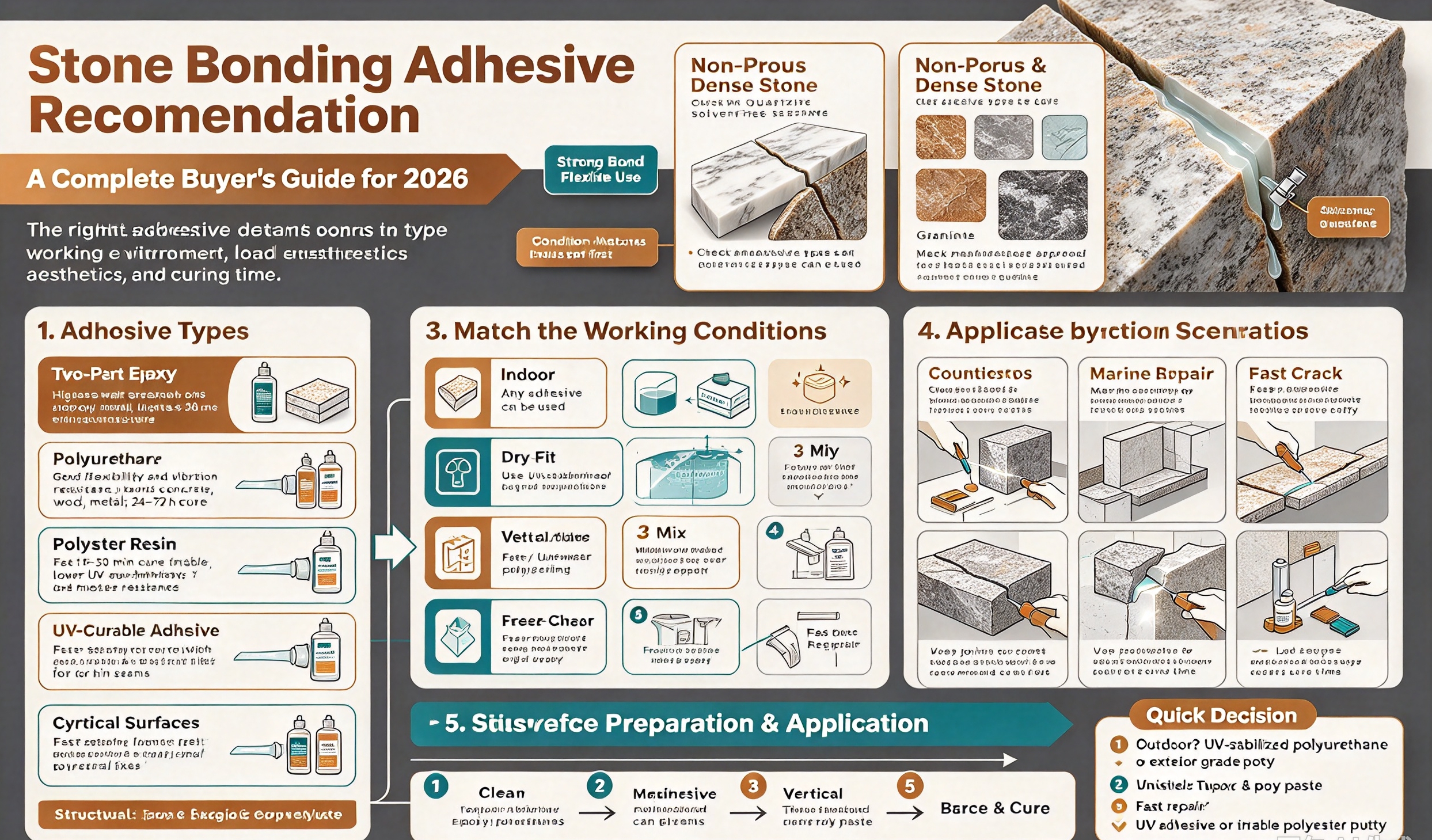
Stone Bonding Adhesive Recommendation: A Complete Buyer’s Guide for 2026
When selecting a stone bonding adhesive, you should be careful when choosing an adhesive if you want your repairs to be
performed quickly and effectively. Stone adhesive means that the adhesive will be suitable for the procedure you are going to perform. There is no need to feel confused with the wide variety of available types of stone adhesives in the current guide. The guide will analyze the classification of stone adhesives and compare the way each category works in real life so that you can make the right choice.
Stone Bonding Adhesive Recommendation: What Category to Choose?
Natural stones and engineered stones differ in terms of their characteristics. They all have their unique characteristics to be taken into account when selecting an adhesive for stone bonding. However, one cannot use conventional building glue for stone bonding as it cannot provide one with the necessary shear strength.
There are five categories of stone adhesives, namely: two-part epoxy adhesive, polyurethane adhesive, marble glue, UV-curable adhesives, and cyanoacrylate adhesive. Each type has its peculiarities. The latest stone epoxy adhesives are supplied either in transparent form or in a stone matching color.A few adhesive products made from stone do not become yellow after exposure to sunlight and can be used in outdoor applications in construction. Stone adhesives can take anything from 30 minutes to 24 hours to cure depending on the kind. Epoxy is highly regarded for its solid capabilities to form bonds between two stones, as well as between stones and metals or concrete, but it may crack in case of thermal movement.
Polyurethane Adhesives
Polyurethane glue should be employed in those cases where moisture is present in single-component adhesives. Although polyurethane adhesive provides a less secured bond compared to epoxy, its good flexibility enables it to sustain effects of vibration. Furthermore, polyurethane can bond with a wide array of materials such as concrete, wood, and metal. The curing time for the polyurethane adhesive is between 24 and 72 hours with limited number of polyurethane adhesive materials out there.
Polyester Resin
This type of adhesive is used extensively in workshops that are working with stone fabrication. The curing time for polyester is 15–30 minutes long. Even though the strength of resin glue is low, it has great tintability. Furthermore, polyester glue is known to be less UV resistant than epoxy. Also, polyester glue is known to turn yellow when exposed to sunlight for prolonged time, hence, it cannot be applied outdoors unless one uses UV stabilized formulations of glue that can be used outdoors. The shrinkage of polyester is more pronounced compared to epoxy.Therefore, it must not be utilized in submersion periods due to its lower moist-resistance capabilities when compared to epoxy’s.
UV Stone Adhesives
UV Stone adhesives are gels that harden almost instantly after UV light exposure. Its main benefits include high transparency, no shrinkage, and invisibility in color all of which help repair thin seams and cracks. UV adhesives are only effective when UV light (usually 365 nm or 405 nm) is present and they are ineffective with too thick and shaded adhesive bonds. Premium UV stone adhesive products, such as Bonstone Glacier, also maintain their non-yellowing character. This material is gel-like and can be used to glue surface at vertical angles. The adhesive is instantly cured provided that light reaches every corner.
Cyanoacrylate (super glue) for Stone
Cyanoacrylate type of adhesives is available only in single-component liquid formulation with the advantage of quick adhesion and rapid solidification upon water absorption. This type is mainly used for instant fixing of surface, albeit there are serious limitations in its formulation. Many cyanoacrilate products are in gel form and demonstrate certain improvements with respect to impact resistance but they are still seen as a temporary solution for bonding rather than a structural one. Nonetheless, cyanoacrylates can be used in specific situations for example as a secondary adhesive for epoxy.How to Select the Right Stone Adhesive
The first factor to consider when choosing a stone adhesive is the type of stone.
For porous stones, such as marble, limestone, travertine, and sandstone, moisture can penetrate the stone, causing the adhesive to stain the surface. It is advised to use non-staining and solvent-free adhesives for porous stones. The adhesives should be tried on a small inconspicuous spot as well. For non-porous, denser stones such as granite or quartzite, all types of adhesives can be applied but approval of the adhesive for heat-cured engineered quartzite should be checked and confirmed with the manufacturer. Soapstone and slate can be bonded with standard epoxy since they are inert. Solvent-based adhesives are not suitable for sealed stones and resin-impregnated stones, as the solvent will remove the sealant from the surface.
The next step is to consider the conditions of working. In case of working indoors, any adhesive can be used. When it comes to outdoor activities, it is necessary to use UV-stabilized adhesives. For wet and underwater situations, waterproof epoxy or polyurethane should be used. If the object is under freezing and melting cycling, then polyurethane is preferred to rigid epoxies, which might crack under this influence. If working in the high-temperature conditions, thenFinally, you are going to evaluate the loads connected with the adhesive usage. Non-structural decorative joints can be made with the help of polyurethane or construction adhesive that can be also used to arrange landscape edges and veneer applications. Seams that need to be invisible and seamless once polished require the usage of either tintable epoxy or polyester for grinding purposes after curing. In case of the need for the filling of large gaps or working with non-smooth seams, one may use thixotropic epoxy pastes that do not sag when applied to vertical surfaces rather than low-viscous liquid epoxy.
Consider Aesthetic and Colour Coordination Needs
Seams that need to be visible when polished can be treated with the use of colour-matching epoxy or polyester that may be later polished after curing. If one wishes to achieve the maximum invisibility while working with light stones, one should apply clear or translucent UV adhesives. In the case of dark-colored granite, standard epoxy may be used with the dye added. In any case, it is advisable to apply adhesive products to other stone products before working to avoid unpleasant surprises when the adhesive is applied visibly.
Best Stone Adhesive Under Different Conditions
As for countertops, it is efficient to use sticky glues such as two-component structural stone epoxies. There are also brands that offer epoxies for stone purpose including those such as Bosco, Tenacet, Akemi, and Stone Tech.Polyester glue is speedier than epoxy but its application is restricted to factory use only. High-tack polyurethane construction adhesives or two-part exterior-grade epoxies designed to endure varying weather conditions are the best choice for such situations. Bostik H980 High Tack Premium is one of the examples of good-quality products designed to be used for natural stone facades which aren’t leaving stains. Traditional polyester marble glues should be completely avoided because they are going to turn yellow in some time. Thixotropic adhesives also called non-sagging adhesives should be used for vertical tasks unless otherwise stated by the producer.
Best Adhesives for Marine Surroundings and Hot and Humid Weather
Pool copings, stones in fountains, and even bathrooms need waterproof glues that can withstand all the moisture. The best option in this case is marine epoxy because it is intended to be used in environments where it is exposed to water. Polyurethane marine sealants are also a good choice for the bonding of flexible joints because they ensure not only a good adhesive connection but also a good sealing. Choose an adhesive that can be submerged rather than just one since it is resistant to moisture.
Best Adhesives for Vertical Surface Bonding
When it comes to vertical applications (for example, cladding walls, wrapping columns, and surrounding fireplaces), thixotropic glues are needed to prevent processes of dripping and running off. The best option in this case is a two-part thixotropic epoxy paste since it will keep its state and not move to other areas. High-quality polyurethane construction adhesives can be used for lightweight works too.When bonding surfaces that are glued, it is important to provide mechanical support so that the glued surfaces can be completely cured. To install things overhead, special gel-like epoxy or UV adhesives are used because these types of adhesives cannot fall off during the curing process.
The best way to do quick repairs. When it comes to cracking and repairs which need to be done very quickly, one of the best choices is the use of UV stone adhesive which bonds instant. When requiring some color to the chips, the choice would be the tinteable polyester putty because it should be dried in several minutes and easily sanded. On the contrary, cyanoacrylate gel could be used for small fixings internally but its use should be limited only forIn order to achieve a perfect stone bond, you need to ensure that you properly prepare the surface. Use the following simple guidelines:
1. Clean the surfaces thoroughly using either acetone or isopropyl alcohol to remove grease and dirt. Porous stones should undergo a light sandblasting process or a honing procedure.
2. After cleaning the surfaces, you can dry-fit the joint.The utmost importance of adhering to the recommended mixing proportions should be adhered to while preparing the glue (Adhesive). Incorrect proportions of glue cause bad adhesion.
4. In the case of narrow seams, spatula or putty is used to apply glue on both sides in parts. Apply glue uniformly in layers and clean off the excess glue with the solvent prescribed by the glue manufacturer.
5. After applying glue, brace the joint and leave it for curing. The adhesive should not be loaded and stressed before curing as per the glue guidelines. Cold weather extends the process of curing and should be taken into account.
The two-component structural epoxy is rated among the best stone adhesives for its unique lap-shear strength achieving impressive 4000-6000 psi. This type of glue is recognized in the sphere as the best option for construction and bearing joints. Polyurethane is acknowledged as the second best glue during usage of flexible adhesives and polyester and cyanoacrylate glue rank down the line of non-structural adhesives.
Is it possible to use a regular super glue for granite and marble bonding?
Regular super glue or cyanoacrylate adhere in case of small non-structural cracks and splits in surface stones, but a major drawback of the regular super glue is that it is weakened and cannot support the loads.
Which one of the stone glue types is preferable to use outdoors?
As to outdoor stone works, the two-component polyurethane glue and exterior-grade polyurethane glue are preferable to use; on the contrary, polyester-based marble glue is not recommended for outdoor applications as it tends to yellow when used in direct sun. Always search for freeze-thaw resistance feature in the product specifications.
How to find stone glue of the same color as natural stones?
The best match with a stone should be tinted epoxy or polyester glue blended with color pigments. First of all, it is worth testing the tint on the stone leftovers and waiting for curing as the colors change during drying. Most countertop centers have ready-made colors for the popular stone types.

