
Best glue for stone installation

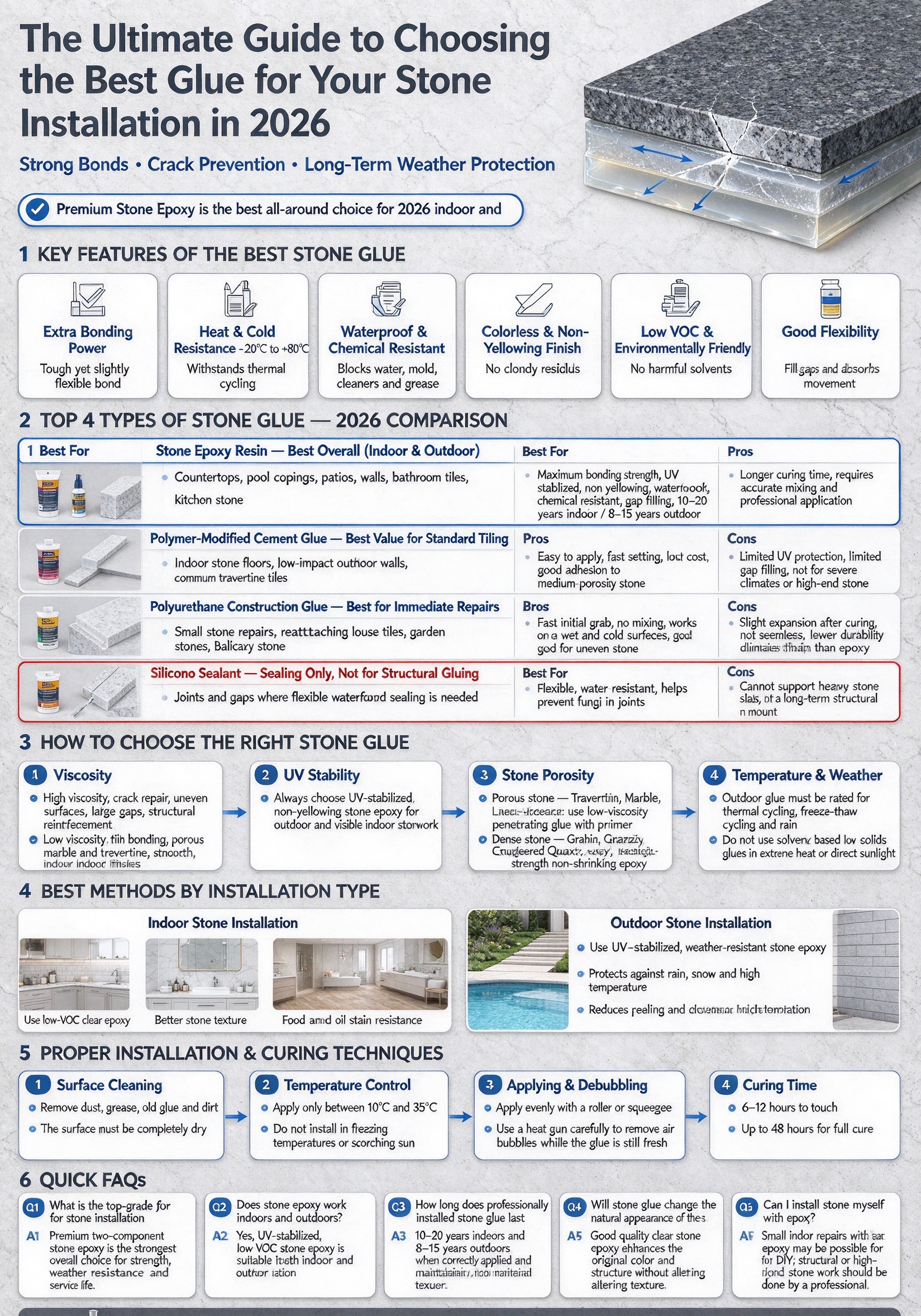
The Ultimate Guide to Choosing the Best Glue for Your Stone Installation in 2026
In order to have durable, crack-free, and weatherproof stone installed at your homes or in businesses, the first thing you need to do is to choose the best glue for stone installation. It is worth mentioning that granite, marble, travertine, quartzite, terrazzo, and fake quartz are some examples of natural and synthetic stones made of stones with surface properties that are porous or dense. Therefore, using the cheapest glue will only lead your newly installed stone to have problems by getting peeled, yellowed, water damaged, or loose within months after the installation is performed. In this updated guide for 2026, you will learn about the best adhesive options, important factors for choosing glue, as well as how to install glue properly.
1. The Key Features of the Best Stone Glue
As opposed to ordinary silicone, wood glue, or construction glue, the best glue for stone installation is a unique and specially engineered adhesive that meets certain industry requirements needed to withstand heavy usage, constant changes in temperature and humidity. Among the most important characteristics, we may name the following ones:
– Extra Bonding Power: It contributes to tough but slightly flexible bonds which can deal with different types of dense non-porous stones (granite, quartz) and porous natural stones (travertine, marble) without falling off.
– Heat & Cold Resistance: Usage of such glue allows the materials to withstand freezing and thawing from -20 °C to +80 °C.
– Waterproof & Resistant to Chemicals: It does not allow water to enter the surface and mold to form there as well as it prevents the stone from being ruined by pool chemicals, cleaners, dirt, oil and grease.
– Colorless and Non-Yellowing Finish: The glue does not change the color of the stone and has no cloudy residues.
#Lowest VOC emissions and environmentally friendly: Contains no harmful solvents and is approved for use in the construction industry.
#Good flexibility: Counters imperfections on surfaces and gaps in joints to eliminate hollows and cracks.
#Top 4 Types of Stone Glue (2026 Comparison)
Not all stone glues can be used for every project. Below are the four best types of glue ranked in terms of performance and versatility for indoor/outdoor stone installation.
#Stone Epoxy Resin (Best Overall for Indoor & Outdoor)
Two-part stone epoxy (resin + hardener) is a top-rated kind of glue chosen for professional stone installation in 2026. This is the only type of adhesive that can create a seamless non-porous bond, compatible with every type of stone. Due to the additives of UV stabilizers and polymers, the premium stone epoxy can prevent many common problems.
#Advantages: Maximum level of bonding resistance, UV protection, does not have yellowing properties, does not fade or crack, resistant to rainy weather, capable of filling gaps, waterproof and resistant to chemicals, lasts for many years (10-20 indoors and 8-15 outdoors), can be applied in glossy or satin finish.
#Disadvantages: Takes longer and requires accurate proportion and professional application when used for large-scale projects.
#Best use: Сountertops, pool copings, patios, walls, tiles in the bathroom, kitchen,Commonly employed in home building, it provides sound slip resistance and basic weather protection.
Advantages: Simple application procedure, speedy hardening, low price, good adhesion features for stones of medium porosity, good for wall and floor paving.
Disadvantages: Bad UV protection, restricted gap-filling property, unsuitable for severe outdoor climate or high-end heavy stones.
Application: Inside the living room, bedroom stone floor; outside low-impact walls, common travertine tile laying.
2.3 Polyurethane Construction Glue (Best Option for Immediate Repairs)
Powerful polyurethane glue for stones gives a solid initial adherence being effective even on wet and cold surfaces. It is a good solution for temporary or permanent stone repair work in any weather conditions.
Advantages: Quick adherence, no complicated mixing, water-resistant, useful for uneven surfaces and urgent repairs.
Disadvantages: Expands after drying a bit, does not give seamless results, has lower durability than epoxy glue.
Application: Small repairs in stones, reattaching loose tiles, decoration of garden stones, bonding stones on balconies.
2.4 Silicone Sealant (Only for Sealing, Not Gluing)
Many people think that silicone sealant is a glue for installation of stones. However, this material is only capable of providing flexible sealing of the surface. It cannot hold heavy stone slabs and cannot provide long-term mounts.
Advantages: Flexible, water-resistant, prevents the fungi in joints and gaps.Professional 2026 Guidelines for Choosing the Right Stone Glue
Choosing the perfect glue is influenced largely by the kind of stone, the place where it’s being used, the type of surface, and other project specifications. Hence, in order to avoid an unsuccessful installation:
3.1. Choose an Appropriate Glue Viscosity
– A high viscosity stone epoxy is ideal for crack repairs and uneven surface bonding, filling large gaps, as well as structural stone reinforcement (in outdoor structural constructions).
– A low viscosity stone epoxy is best suited to be used for thin sealing, penetrating porous stones (marble and travertine) or creating smooth finishes for indoor surfaces.
3.2. Use only UV-Stabilized Non-Yellowing Products
Ordinary epoxy and other cheap construction adhesives can become yellowish and fragile under the sun. When doing work with outdoor stone or visible indoor stone, you should always choose stone epoxies that contain no more than 100% solids and are UV-protected and low VOC.
3.3. Establish whether your Stone is Porous or Dense
– Porous stones (Travertine, Marble, Limestone): Need to be glued with a low viscosity penetrating glue and a primer to ensure adhesion and stain resistance.
– Dense stones (Granite, Quartzite, Engineered Quartz): Need to be glued with high strength non-shrinking epoxy which is able to provide a good bond without slipping.
3.4. Find Out Appropraite Temperature and Weather Performance
Quality outdoor stone glue must be rated for thermal cycling, freeze-thaw cycling, and rain. Do not use solvent-based low solids glues that can melt and form bubbles in extreme conditions.Best Glue Methods by Stone Installation Type
4.1 Indoor Stone Installation
For kitchen surfaces, bathroom stone walls, stone flooring in the living room and accents for fireplace in houses, one can use low-VOC clear epoxy for stone. Stone epoxy provides better stone texture, has good stain resistant properties against food and oil, and means easier maintenance.
4.2 Outdoor Stone Installation
For pavers, pathways, areas around swimming pools, kitchen tops and facades, UV-stabilized weather resilient stone epoxy will serve you well against rain, snow, high temperature and the former will also help to avoid peeling and discoloration.
5. Proper Installation and Curing Techniques for Stone Adhesives
– Surface cleaning: The surface must be free from dust, grease, old adhesives and dirt. The surface must be absolutely dry because otherwise air bubbles will form on the surface preventing adhesion of stone.
– Temperature control: Use the glue only at temperature ranging from 10°C to 35°C. Do not glue the stone tiles at low temperatures or in scorching sunshine.
– Applying and Debubbling: Apply the glue evenly using a roller or squeegee. Use the heat gun to remove air bubbles from the surface when it is still hot.
– Curing time: The glue needs to cure for about 6–12 hours for it to be touched. Full curing will take up to 48 hours.Commonly Asked Questions (FAQs)
6.1 What is the top-grade glue applicable in stone installation?
The premium stone epoxy features two components which place it among the strongest adhesives suitable for stone עבודה. This kind of glue has the best performance compared to polyurethane adhesives, silicone glue, and polymer adhesives in terms of strength, weather resistance, and life span.
6.2 Does stone epoxy work for both indoor and outdoor stone application?
Yes. The stone epoxy containing UV-stabilizers and low VOC levels is developed for the use both for indoor and outdoor purposes because it can adjust to the climate conditions.
6.3 How long does stone work glue last if installed by a professional?
The life span of the surface treated with epoxy glue depends on how proper it has been applied and maintained. If a licensed person performs installation correctly, the materials will last for 10-20 years indoors and 8-15 years outdoors, which is significantly longer than when applied with regular glues.
6.4 Will stone glue change the natural appearance of the stone?
The use of good-quality stone epoxy made of a clear type will bring out the original color and structure of the stone without changing the texture of the materials used.
6.5 Is it possible to install a stone surface by oneself with the help of epoxy glue?
Some small indoor repairs are possible to be completed with the help of the clear glue in one’s own house.
7. Conclusion
The epoxy stone glue is the best glue for indoor and outdoor projects in 2026 no matter what. It shows the great efficiency of working, taking into consideration the following aspects: greatest strength, best weatherproof performance, aesthetic improvements, and overall economy. However, in the case of standard low-traffic tiling, polymer-modified adhesive can serve as a cheap alternative, while in case of quick repair work, polyurethane glue is the best option.

