
Epoxy glue for stone fabrication

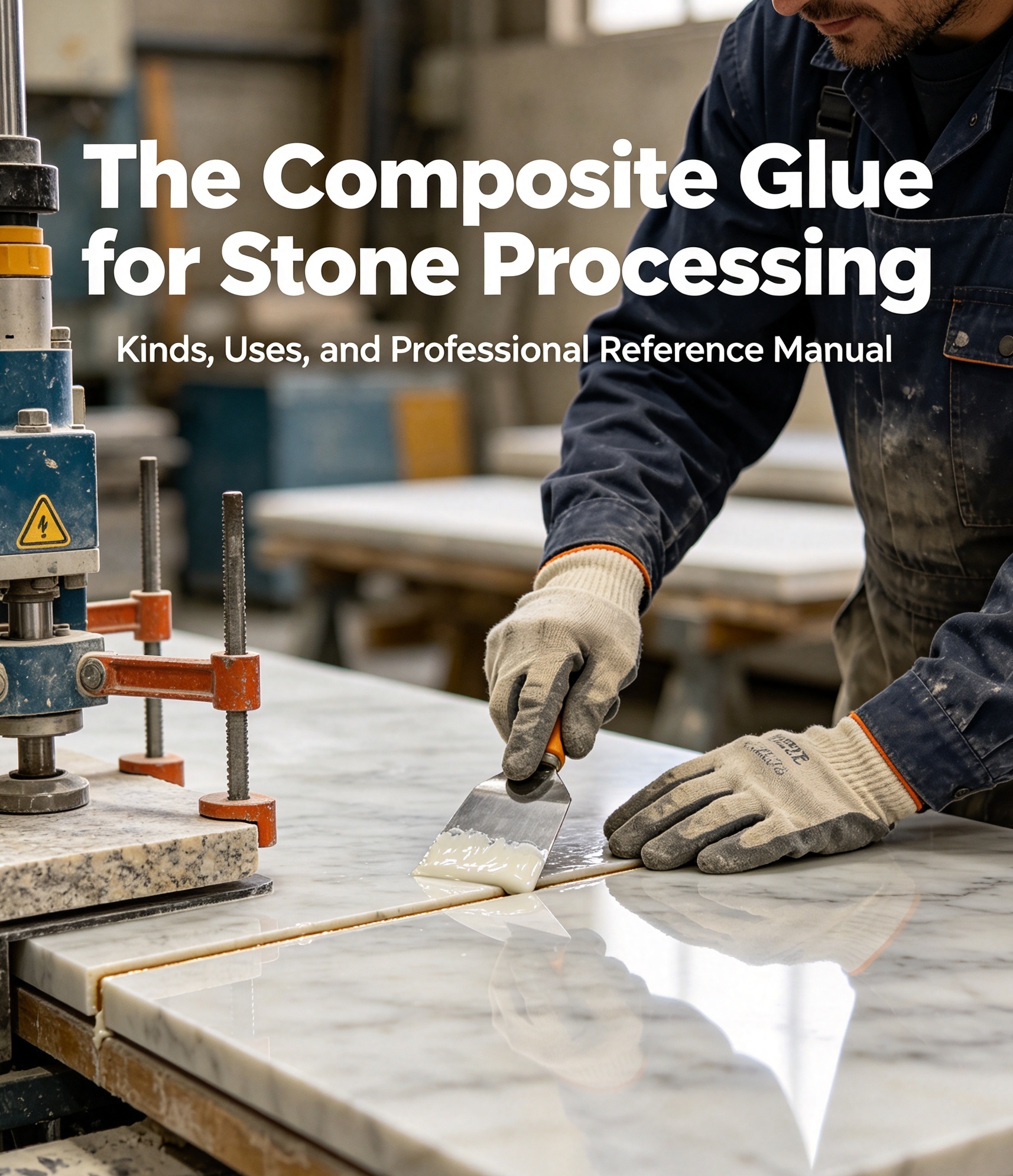
The Composite Glue for Stone Processing: Kinds, Uses, and Professional Reference Manual
Composite glue is the most prevalent structural adhesive in the stone processing industry, whether it is about granite, marble, quartz, travertine, or artificial rock. As a two-component adhesive based on chemical reaction (resin + hardener), it allows for reliable adhesion, little shrinkage, and weather resistance. The following information outlines the main facts regarding composite glue, its types, use cases, and the major rules of applications.
1. Key Benefits of Composite Glue for Stone Processing
Unlike solvent adhesives that function through the evaporation method, composite glue works through the chemical reaction of resin to hardener which helps achieve stable results regardless of the access to air and other drying conditions. Below listed are the unique features provided by composite glue that make its use possible in large-scale stone processing:
– Low Bond Failure Rate: Composite glue has been proven to provide a shear strength of about 4000-6000 PSI which is twice as high as that of polyester glue. Its usage allows for bonding dense, low-porosity stone surfaces and supports load-bearing structures.
– No Shrinkage at the Point of Curing: There are no cases of gaps or cracks.
– High Environmental Safety: The material is water and moisture resistant and without using any chemicals.It is able to resist indoor humidity levels as well as outdoor sun damage (UV-protected formulas) without risking adhesive failure, fading, or flaking for many years.
– Good Filling Properties & Compatibility: Viscosity that can change for other stone cracks, gaps, or uneven joints surfaces. Can work with any kind of natural and synthetic stones while not reacting with them.
– Adjustable Appearance: Comes as a clear, black, white or stone-colored product. Can be colored to match the stone tones underneath it in order to create an invisible surface and make the products look perfect.
2. Types of Stone Epoxy
Stone epoxy is classified into viscosity types, speed of hardening, and formula types.
2.1 Low Viscosity Penetrating Epoxy
A thin and fluid material that guarantees good penetration. A perfect adhesive for stone cracks, micro-pores damage repair, and restoration of damaged stone materials.
2.2 Medium Viscosity General-Purpose Epoxy
The most typical ones. This kind of epoxy is a good balance in terms of viscosity and filling ability. Ideal for common stone bonding, slab joining, and small repairs upon the stone surface.
2.3 High Viscosity Gap Filling Epoxy
A thick product that does not flow. Such material is extremely useful for repair of uneven stone joints or vertical surfaces, which would not be possible with regular formulations.2.4 Fast-Curing & Slow-Curing Epoxy
Fast-curing epoxy is a kind of epoxy that fully sets in one or two hours, which makes it very useful for speedy prototyping, urgent repair works, and running efficient production plants. The slow-curing epoxy takes from six to twenty-four hours to cure properly and is very effective in getting rid of bubbles, as well as creating a uniform bond layer and hence performing complex fixed bond works.
2.5 UV-Stabilized Outdoor Epoxy
Contains an innovative anti-yellowing formula and UV-resistant agents to ensure protection from aging, discoloration, and bond degradation because of the sun and rain exposure for a long time. It is used exclusively in outdoor stone applications, like exterior wall cladding, landscape stone applications, and outdoor countertops.
3. Major Applications for Stone Processing
It is important to note that epoxy is used throughout all critical technological operations connected with stone treatment and the task of fixing issues of general importance in stone processing and installation works:
– Stone Slabs Bonding and Splicing: This includes the process of bonding slabs made of granite, marble, and quartz, putting together mitered corners of countertops, and rectifying the issue of splitting of granite plate.
– Cracks Cleaning and Restoration: It implies that natural cracks are filled with the help of epoxy and that holes and white spots that appear on stone surfaces are filled with this type of glue.
– Fixing and Reinforcement: This means filling anchor bolts in dry-hanging stone plates using stone, reinforcing sink cuts and edges of stone, combining this material with either metal or concrete.
– Artificial Stone and Composite Panel Creation: This means that a combination of stones can be done by using glue, and the press provided under vacuum gives the opportunity to apply one-layer glue to our composite panel.• Inside and Outside installation: Applying stony floor, wall systems, stair offshoots, and landscape stone, suitable for the moist conditions of a kitchen or a washroom and outdoors. 4. Formal practices of construction. Effective working according to the regulations is necessary to succeed in the use of epoxy. 4.1 Preparation of the surface (The main stage.) The polished surface of stones has low adhesion. Thus, the place, where the adhesive is applied, should be rinsed properly with the help of abrasive devices of 60–80 degrees. Hence, during the process not to leave dust, oil, wax, or the moisture remaining in the surface, use compressed air or acetone cleaning solution. Do not apply an acid cleaning solution for calcium carbonate stones, since it will wreck the surface, so that it would not adhere properly. Ensure that the stones are dry and clean beforehand. 4.2 правильное пропорционирование и смешивание. Carefully adhere to the regulations of the product about the ratio of resin and curing agent (in most cases the ratio is 2:1). Measure both products accurately, mix properly until the mixture turns visually the same. 4.3 Coating and laminating. Apply a uniform layer of epoxy onto the surface with the help of a scraper. In the case of the presence of gaps, fill them with glue, but ensure that there is no glue overflow.Align all the stone elements perfectly, apply uniform pressure, and secure them using clamps or vacuum machines to remove excess glue and air bubbles inside.
4. Curing & Post-processing
Finish the first stage of curing within the specified working time and avoid moving or disrupting the stone objects when they are curing. Laying of glue will take 12–24 hours (it depends on the formula and the temperature). After the glue has been cured completely, polish the remaining glue and joints to get a smooth stone surface.
5. How to Choose the Perfect Epoxy for Stone Fabrication
– Match the stone type: Use colored epoxy today clear epoxy for high-quality transparent stones to keep the texture. Use high-hardness reinforced epoxy for brittle porous stones; it will offer more crack resistance.
– Decide its environment: Use a regular ordinary epoxy for decorating materials inside. For outside and wet area projects, pick the one that is UV stabilized, waterproof, and weather resistant.
– Adjust the effectiveness: Pick up a quick curing epoxy for speedy mass production. Use slow curing high precision formula for custom stone objects that will pass the highest standards.
– Pay attention to the structural use: Use high strength structural epoxy for load bearing features and dry-hanging stone; use low viscosity penetrating epoxy for repairs and fixes.
6. Key Issues & Their Solutions
– Lack of Curing and Soft glue layer: If the proportions were not respected or the glue was incorrectly mixed. Solution: Follow the constituents proportion, and stir properly.
– Yellowing of the Surfaces: If an ordinary glue was used outside. Solution: Use UV stabilized glue for external projects.
– Bubbles in Glue layer: If the glue coating was not even or the sufficient pressure during lamination was not applied. Solution: Make use of a vacuum process when working large quantities of products and ensure proper glue bubble removal during the process.
– Weak bonding properties: If the stone surface was not cleaned or dried beforehand. Solution: Arrange proper cleaning and drying procedures.
7. Epilogue
Epoxy glue represents today’s strongest adhesive for the stone processing, having excellent combination of strong adhesion and durability, beauty and tolerance. If viscosity, curing time, and functional properties are chosen correctly in accordance with the correct surface preparation and mixing of epoxy at the stage of application, it would lead to producing high-quality stone products.

