
Strong glue for stone to metal

Strong Glue for Stone to Metal: Top Adhesives, Application Suggestions & Performance Tips
Bonding stone and metal is a prevalent but difficult issue in construction, interior renovations, outdoor landscaping, and industrial production. Stone materials like marble, granite, quartz, and natural bluestone are porous, rigid, and low-thermally expanding materials. Metals, such as steel, aluminum, stainless steel, and brass, have smooth, non-porous, and good thermal conductivity characteristics. Therefore, the significant differences in their physical features make ordinary glues ineffective at bonding stone and metal and cause all problems with weak bonding, peeling, cracking, and loose joints. Hence, the importance of choosing a proper powerful glue for stone to metal bonding cannot be overestimated. In this article, various types of adhesives will be discussed, including the main performance criteria as well as the application process along with the important tips from professionals.
1. The Reasons Why Regular Glues Don’t Work for Bonding Stone and Metal
The majority of universal adhesives, super glues, and construction sealants are created for dissimilar materials but nonetheless don’t work well for stone and metal bonding. There are some major reasons for their failure:
– Differences in porosity: Natural stones have micro-pores that suck them in, but at the same time smooth metal surfaces don’t allow glues to make mechanical bites as a result of what the adhesion force is insufficient.
– Differences in thermal expansion coefficients: Metal expands a lot when temperatures change, meanwhile stones do not change at all. Moreover, conventional viscous glues cannot cope with this structural tension that appears due to temperature fluctuations.
– Lack of environmental stability: Regular glues do not have waterproof, UV-proof, and weatherproof properties and cannot survive in outdoor humid, wet, or hot conditions.1. Insufficient ability to fill gaps: Rough surfaces of stones produce tiny gaps. Standard adhesives cannot effectively fill the gaps, producing hollow bonding and decreasing strength.
2. Top 3 Types of Strongest Glue for Stone to Metal
When it comes to strong adhesives used in the vicinity stone-metal, three types of adhesives with different characteristics dominate the professional market.
2.1. Two-Part Epoxy Adhesive (Best for Permanent Structural Bonding)
The two-part epoxy AB glue is considered to be the strongest adhesive when dealing with stone-metal bonding. It contains two parts: resin and hardener. The two parts make a chemical reaction to form a solid bond that is very strong.
Main features: Very high strength (over 3000 PSI),Essential benefits: Flexible and resistant to mechanical shocks, does not leave a stain on natural stone materials and does not lead to yellowing of the stone or corrosion of its surface, has remarkable effectiveness against UV rays and weather conditions; with excellent adhesion properties, has a low odor profile and is produced from eco-friendly ingredients. Able to stick slightly damp surfaces and does not require pre-application of a primer.
Most suitable uses: Outside applications for fixing metal railings made of stone, joining metal elements in landscaping stone works, exterior wall decoration works and at humid places.
2.3 Polyurethane Structural Glue (Best for Movement and Vibration)
This type of glue is considered a strong one thanks to its properties making the bonding process reliable even in dynamic and vibrating conditions.
Essential benefits: High adhesion and impact strength, heat resistance, water and mold resistance making the glue suitable for cold and hot temperature changes.
Most suitable uses: Use of the glue for stone elements in vehicles and machines
3. The main performance characteristics of stone-metal glue
To choose the strongest adhesive for your bonding process one has to pay attention to the following points:
– Bonding strength: it is reasonable to choose structural adhesives with tensile strength higher than 2000 PSI for load
– Weather resistance: the adhesives used for outdoor works should be water and UV resistant as well as resistant to temperature changes from minus 20 to 80 degrees.
– Compatibility with stone: one has to use non-corrosive, non-yellowing, and non-staining compounds to make sure that the natural impact of the stone will not change due to glue application.- Performance in filling gaps: Be capable of contouring uneven stone surfaces in order to achieve perfect cooperation and consistent force distribution on the bonding surface.
– Curing term: Use fast curing formulas for faster construction; use slow curing high strength epoxy for accurate positioning and superior final strength.
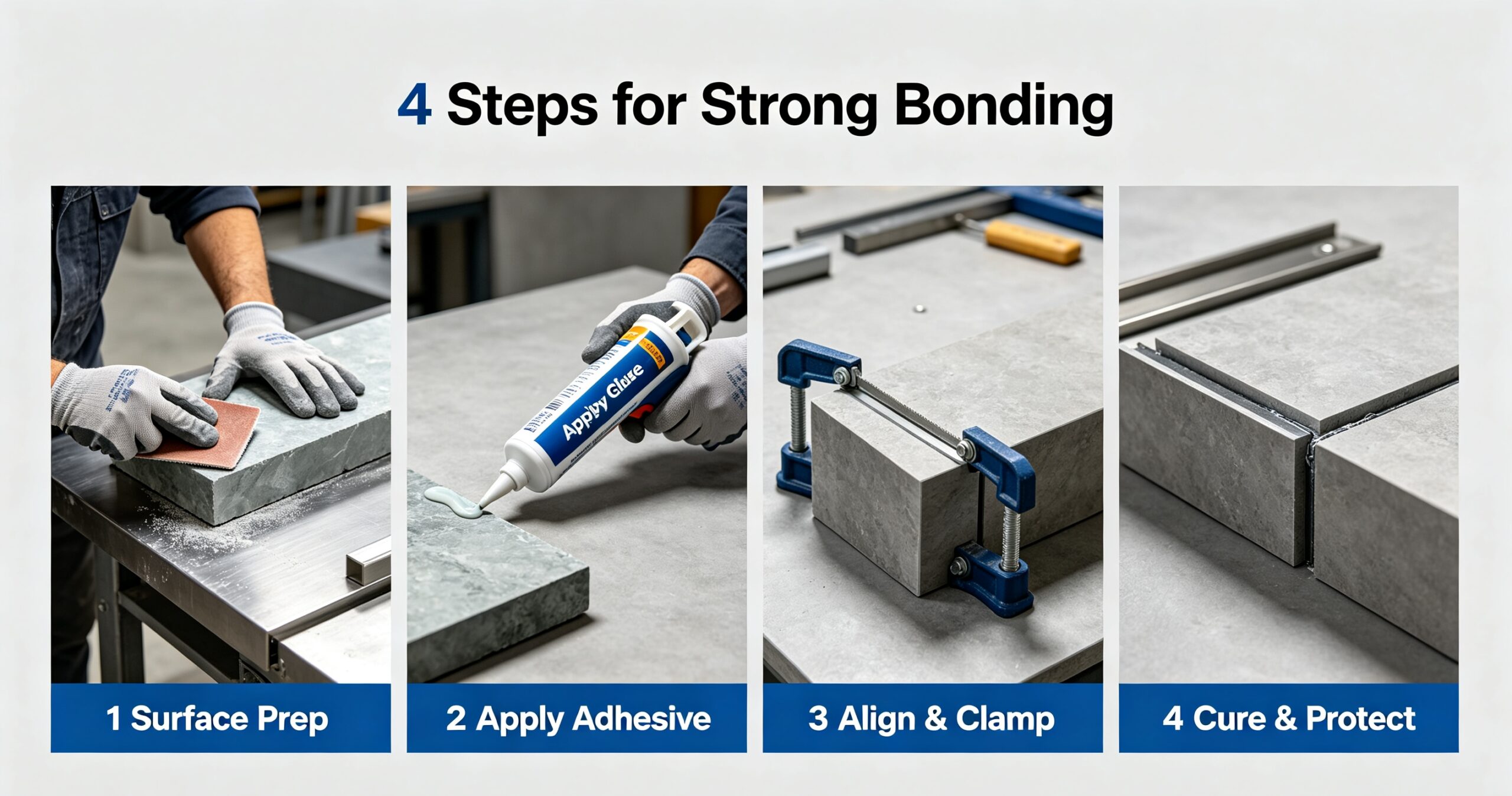
4. Detailed Instructions for Optimal Bonding Strength
No matter how good the glue is, negligence during the process will compromise bonding strength. Follow the instructions below to get the desired effect:
Step 1: Surface Preparation (The most important step)
Make sure that all dust, dirt, oil spots, rust, and old glue residues have been completely removed from the surfaces of the stone and the metal. In case of flat metal surfaces, make sure that the surface is slightly polished with sandpaper in order to increase the roughness of the surface and mechanical adhesion.
Step 2: Mixing and Applying the Adhesive
If you work with two-component epoxy glue, combine resin and hardener in the right ratio. If you work with glue belonging to one-component MS polymer or polyurethane adhesive, ensure that the adhesive is applied evenly across the bonding surface with the help of a scraper or glue gun. Make sure that you control the thickness of the applied adhesive.
Step 3: Placing the Pieces at a Fixed Position
Put the stone and the metal together tightly without any gaps and apply pressure for about 3-5 minutes in order to get rid of the air inside and ensure good contact of the adhesive with both materials. For heavier materials, make use of temporary brackets, adhesive tape or any other kind of mechanical device for fixing the position and preventing slippage in the course of the curing process.
Step 4: Curing & Post-Protection
Attend to the initial curing process within the time frame of 1 to 3 hours, which is followed by the full-strength curing process within 24 hours (the epoxy glue needs a span of 24 to 48 hours to attain the maximum strength). Do not allow for any pressure or water disturbance during the curing time so that the bond formation remains stable.
5. Frequently Asked Questions Regarding Glue Bonding Heavy Stone to Metal
Q1: Is it possible for the glue to create a permanent bond between heavy stone and metal?
Yes, the usage of good-quality epoxy structural two-part glue will enable the permanent bond to be established. In the case of extremely heavy stone materials, it would be advisable to supplement adhesive bonding with additional mechanical fixation for the sake of ensuring safety and durability.
Q2: Which types of glue are most suitable for outdoor use when bonding stone with metal?
The best kind of glue to be used outside is the MS polymer hybrid adhesive as it is resistant to the harmful effects of weather, UV rays and stresses rendering it more effective in resisting aging and cracking whenever the stones are exposed to direct sunlight and rain for a long period.
Q3: Will the glue stain natural stone surfaces?
Professional adhesive for stone-metal works is up to par as it is non-staining. It is advisable to avoid the use of inexpensive common epoxy glue and super glue, as these are known to produce the yellowing effect and penetrate into the stone.
Q4: Will bonded joints resist temperature fluctuations?
Yes, the professional adhesives possess properties that allow them to withstand changes in temperature. Flexible MS polymer and polyurethane glue may absorb the strain that occurs during the thermal expansion and contraction process for both stone and metal.
6. Conclusion
In order to join stone with metal it is necessary to use the correct type of glue for stone to metal instead of connecting adhesives. Using two-part epoxy glue will provide for strong connection when working with indoor load-bearing structures, while MS polymer hybrid adhesive is preferable for outdoor usage.