
How to bond stone to steel

How to Connect Stone to Steel: A Thorough Practical Guide ensuring Long-Lasting Results
The joining together of stone and steel is required in building construction, renovation work and home furnishing projects and outdoor landscaping. The characteristics of stone (such as granite, marble, quartz and travertine) which represents the stone and steel that includes stainless steel, carbon steel, and structural steel differ from one another. Although the steel is heavy, smooth, and hard, stone is light, fragile, and capable of holding moisture. Due to this fact it makes adhesion quite difficult. If a person does not have necessary materials and experience there is always a great chance that the bonded connection will unstick due to temperature variations, vibrations, and moisture.
This text will offer several simple and practical techniques which can be used in the process of bonding stone and steel. It consists of instructions regarding choosing adhesive materials, preparing surface, the process of bonding, avoiding mistakes and strengthening methods.
1. Problems connected with the bonding of stone to steel
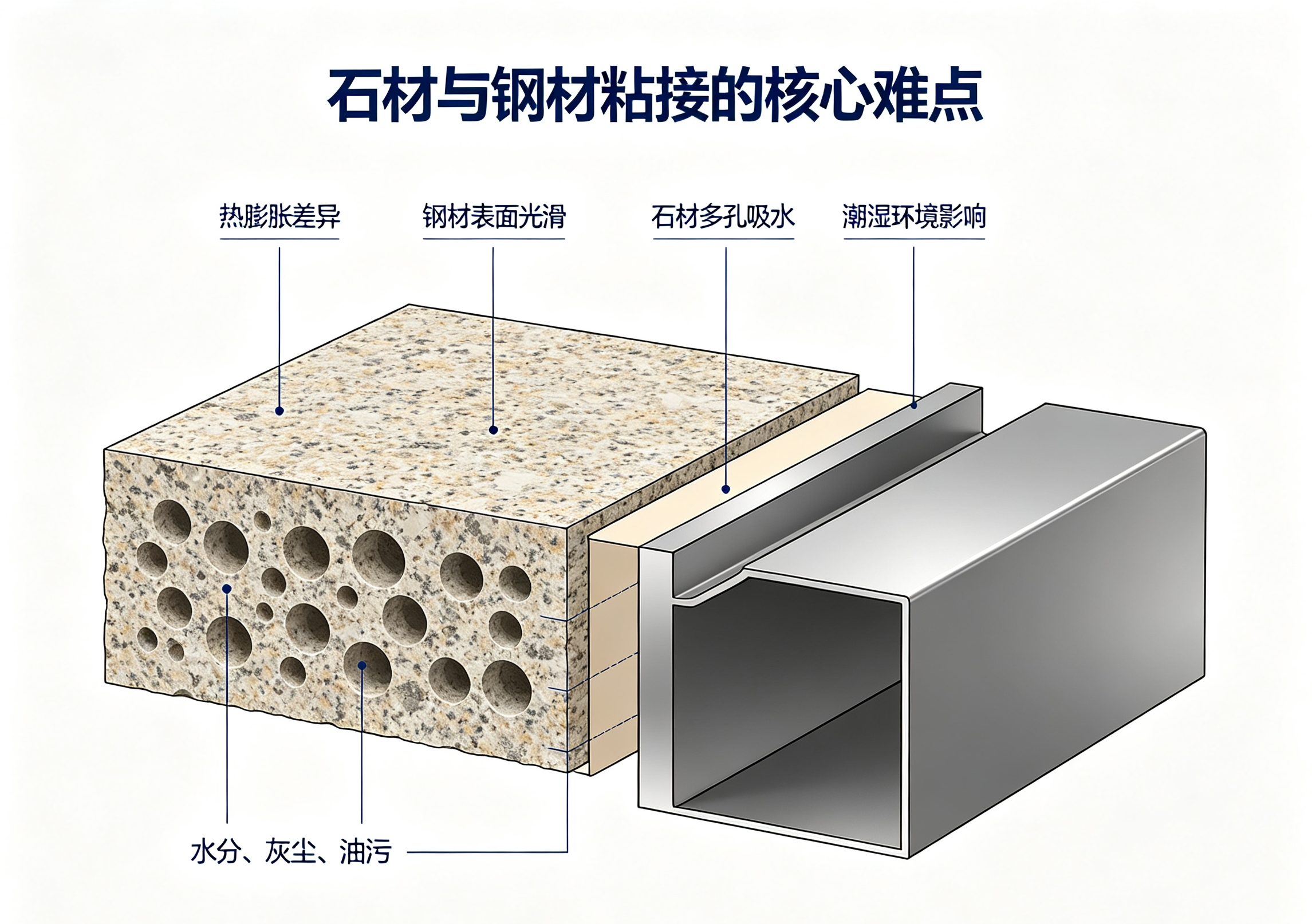
Knowing about main problems that may arise during your work one will be able to avoid problems in bonding.
– Thermal contraction of metals which is larger than of the stone. Ordinary adhesive glue would not be strong enough, thus the joint would crack.
– Steel doesn’t have rough surface, thus it does not allow adhesives to stick to it.
– Stone is porous which makes it capable of absorbing moisture while obtaining adhesive.
– Environment matters, such as humidity and rain will corrode the joint over time.
2. Best kind of adhesives to use for connecting stone to steel
Selecting an adhesive makes up 70% of the success of adhesiveDifferent situations necessitate the use of a specialized type of adhesive; universal adhesive is not sufficient for structural adhesive bonding for long periods.
2.1 Two Compounds Structural Epoxy Adhesive
Two-component epoxy adhesive (resin + hardener) is the main type of glue used for stone-metal connections. Its attributes include high shear strength, good weatherproofing, low shrinkage after curing, and solid thermal deformation resistance. You can use it for heavy stone plates, vertical installation, and outdoor elements.
Advantages: Waterproof, not aging, resistant to vibrations, no hollow bond.
Possible forms of use: Wall stones, stones furniture, outdoor landscape sites.
2.2 Hybrid High-Grip Adhesive
This fast-setting adhesive acts instantly, thus making it possible to attach light stone materials to metal surfaces without any pressure. This adhesive saves stone surfaces from damage.
Advantages: Effortless application, excellent adhesion on-site.
Possible forms of use: Light decorative stones, indoor bonding.
2.3 Special Stone-Steel Adhesive Mortar
This type of stone mortar is compounded with polymers and can be used to glue large stone surface pieces on the metal support.
3. Surface Preparation
Preparing a surface is the most important part of bonding. If the surface is dirty, flat, or rusted, even the most sophisticated glue will not hold.3.1 Procedure of Steel Surface Treatment
– Cleanup contaminants: The first step in preparing steel surface is to remove rust, oil, old glue residues and dirt using degreaser or alcoholic solution. The presence of grease on the surface may prevent the proper adhesion of glue.
– Increase surface roughness: The second step is polishing adhesive contact area using 120-180 grit sandpaper to establish tiny grooves on the surface. This will allow acquiring better grip (also known as mechanical bite) of adhesive grain with smooth steel surface.
– Cleaning: Wipe the polished steel surface again with a clean cloth soaked in alcohol and dry it out completely (the absence of moisture is essential) 3.2 Procedure of Stone Surface Treatment
– Dust and moisture removal: Cleanup the back of the stone from dust and ensure its surface is completely dry.
– (optional but recommended) Sealing for anti-first penetration and hollowness during working with such porous stones as travertine or limestone, you should apply a layer of waterproof sealant.
– (important) Protect the decorative surface of the stone by covering it with some protective film.
4. Steps of Bonding Implementation
The following steps should be applied to achieve flat and reliable bonding (which covers more cases of stone and steel bonding).
Step 1: Adhesive mixing (if epoxy adhesive in two components is used).
Mixing of component A and component B of adhesive must be done by following required proportions (they must have the equal volume). The mixture should be stirred with a wooden stick for 60-90 seconds or until getting the mixture of uniform color.Mixing the adhesive should not be done in a hurried manner since this may result in the creation of excessive air bubbles, which will interfere with the bond density. The adhesive should ideally be mixed at site and used while it is still in the working life.
The work surface should be free of debris and cleaned before applying the adhesive uniformly onto the various surfaces.
In the case of larger stone panels, various forms of application strategies such as spot application and full surface application should be utilized to ensure that the stress is uniformly distributed.
After the stone is properly placed on the substrate, it is necessary to keep it pressed down firmly so that any air bubbles are expelled.
When carrying out operations on vertical surfaces or heavy materials, it is advisable to utilize clamps or other materials in the short term to hold the material in place.- Use high-strength epoxy glue that can withstand load forces and wear/tear, together with rivets or screws to take the load.
– Leave 1-2 mm gaps around the bonding area in the outdoor applications to allow for the expansion and contracting due to temperature changes matching the adhesion curing time.
– Cover the steel edges of the bonded components to prevent their corrosion from pressing against the stone and causing it to crack.
6. Common Errors in Stone-Steel Bonding
– Not polishing the surface: Not polishing the joint means that the surface is smooth and will result in poor adhesion.
– Not mixing the adhesive properly: Failing to mix the two parts of the epoxy results in partial curing, leading to weak adhesion.
– Applying thick layers of adhesive: Thick layers of the glue can result in cracks, as heavy shrinkage occurs during curing.
– Using the bonding too early: Using the joint before curing will cause permanent damage.
– Not considering humidity: Working in humid conditions can decrease the bond strength due to adhesive failure.
7. Final Maintenance
After adequate curing, excess adhesive can be wiped off. Over the years of use, it is essential to check whether fungus occurs.
Conclusion
Quality bonding of stone to steel relies on three fundamental principles: the use of the proper adhesive for stone-steel bonding, pre-treatment of the surface, and properly controlling the curing process. A two-part epoxy glue is the best option for a durable bond between stone and steel.