
Best epoxy for stone bonding

The Comprehensive Handbook for Choosing the Right Epoxy for Stone Bonding: Expert Selection and Use
In recent years, stone bonding epoxy has become an essential adhesive material in the field of construction and installation of natural stone and engineered stone. Unlike common adhesives, stone bonding epoxy has unmatched features such as superior bonding strength, durability under different weather conditions, resistance to fading and shrinkage, thereby making it perfect for the physical characteristics of porous natural stone (marble, granite, travertine and quartzite) and solid artificial stone. Choosing the best epoxy formula is very important for avoiding stone structure issues like hollowing, cracking, discoloration and peeling. This article provides a comprehensive approach to the selection criteria, top quality epoxy products, rules for matching epoxy to the particular use and methods for effective use of stone bonding epoxy.
1. Main Key Criteria in Selecting an Epoxy for Stone Bonding
Natural stone has specific physical properties such as different degrees of porosity, coefficient of thermal expansion and roughness of its surface. Therefore, normal universal epoxy has lots of problems, such as poor penetration, bonding failure, yellowing and damage of the substrate in the process of usage. Hence, in order to cope with engineering challenges, professional stone bonding epoxy has to meet the following key requirements.
1.1 Matching of viscosity and application suitability.
Viscosity is the major factor which determines applicability of the epoxy for use in stone bonding.
Low-viscosity epoxy (500-1000 mPa·s) boasts excellent fluidity and permeability. It can penetrate microscopic pores and microcracks of stone surfaces, fills in less than 0.5 mm gaps and forms a uniform layer of adhesion with the stone substrate. It is applicable for repairing fine cracks in stone material, seamless joining of very accurate stone plates and filling gaps of dense stones like granite and quartzite. High-viscosEthics in weather-proofing and tie-dyeing
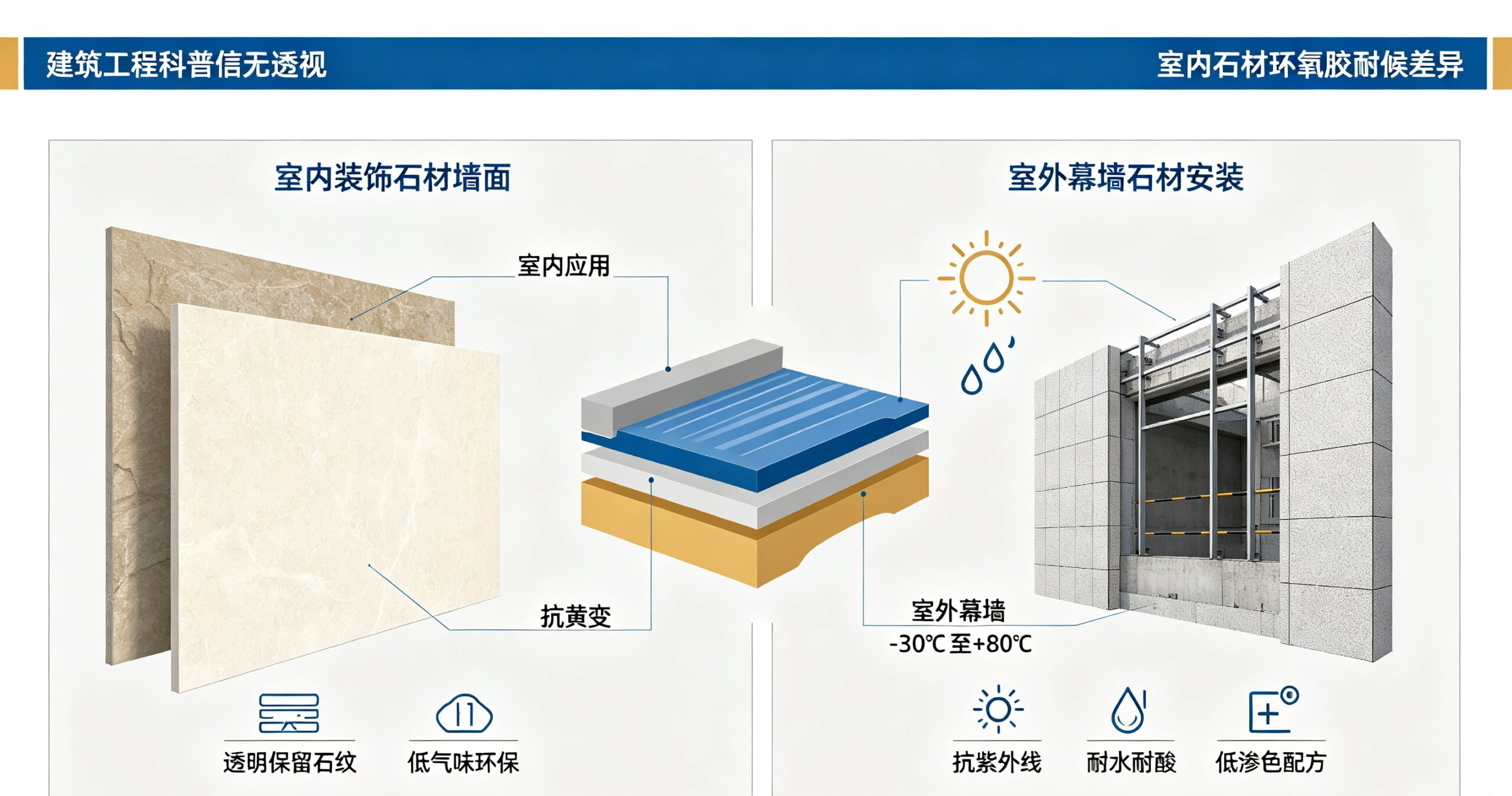
Film-forming technology divides its area into two parts for indoor decoration and outdoor curtain walls, which gives rise to some specific requirements for weatherproof materials with respect to epoxy materials. When installing stones indoors, it is necessary to take on its anti-yellow features of good clear epoxies that make them able to remain transparent while leaving the surface of stone natural. Outdoor epoxy should have quality features allowing it to survive under the effect of sun rays, cold with temperature down to -30 degrees Celsius, hot with temperature reaching +80 degrees Celsius, resistance to water and acid, as the outdoor epoxy will suffer the effects of sun, rain, and temperature variations. The UV radiation will cause yellowing and aged connection layers to be formed during operation. Finally, special low-staining formula does not allow chemicals to penetrate light stone surfaces, such as light marble and beige travertine. Safety and compatibility with the surface
Professionally used stone epoxies do not have styrenes and poisonous substances, do not have unpleasant smell, and do not emit anything after curing that fulfills the requirements for environment protection. This implies that this epoxy has good compatibility with all types of stones yet does not create chemical reactions due to stone mineral composition without the presence of alkali inside. For special underwater stone installations and wet conditions, curing the compound binds well and achieves all its qualities without any problems. Best stone adhesive
Many varieties of stones have been examined using both practice and theory such as structural and position fixes, vertical installation systems, as well as other configurations. LATAPOXY 310 stone adhesive
It is a traditional two-component epoxy aimed for stone gluing and vertical installation. It is the easiest process since its mixing ratio is 1:1. Its great feature is that it does not sag, and at +35 degrees, the material stays stable.
Megapoxy 69