
Stone adhesive for heavy load bonding

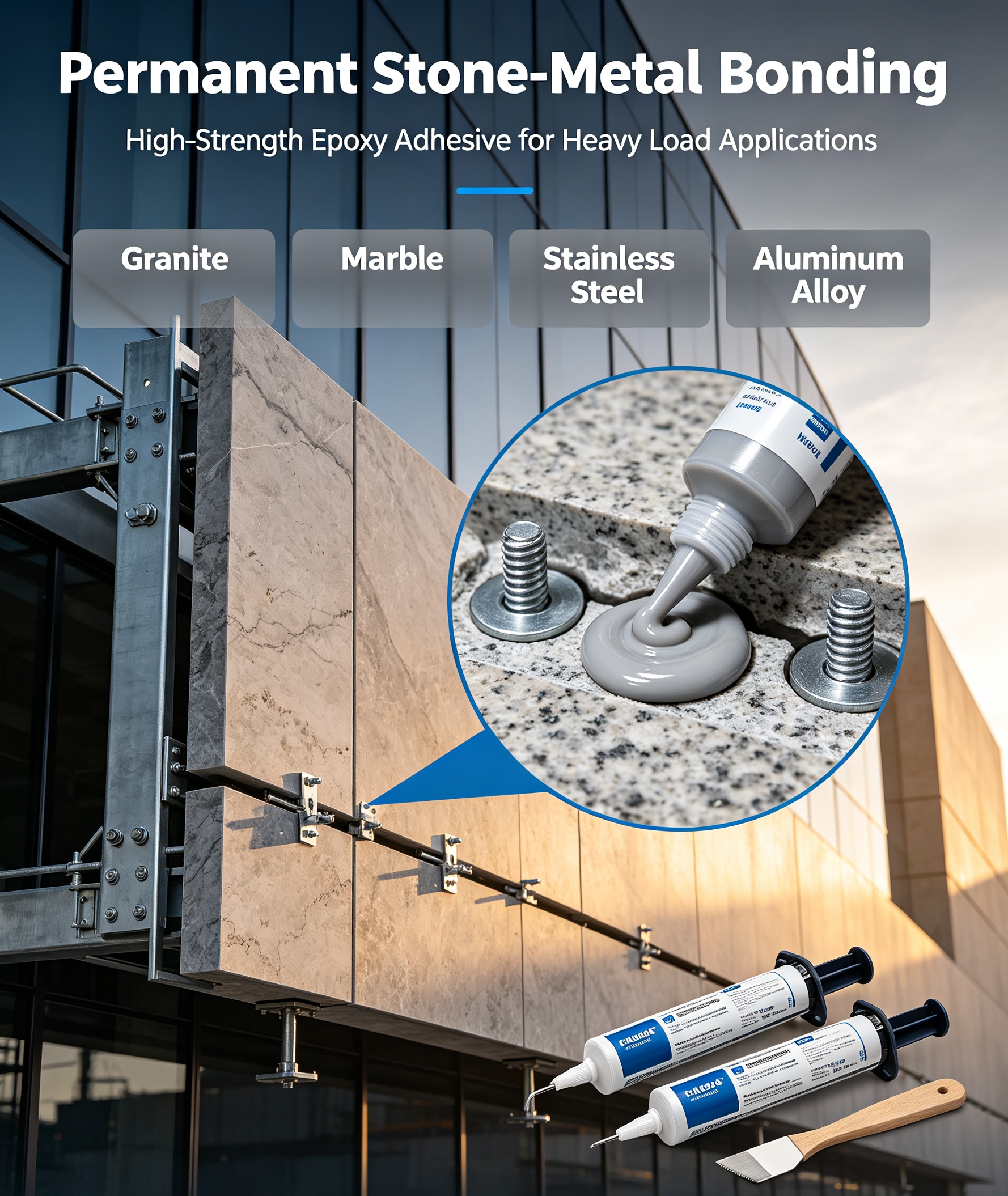
Heavy Load Stone Glue: High-Strength Epoxy for Permanent Bonding Stone to Metal
1. Introduction: Why Regular Glue Works Badly for Heavy Load Stone Adhesives
Heavy load stone adhesive is an important structural process utilized in architectural façade installation, industrial equipment assembly, marine engineering construction, and building rehabilitation. Regular heavy stone materials include granite, marble, bluestone, and engineered stone, which have the properties of porosity, low toughness, and high mass. In most ways, these stone materials need to have stable adhesives with solid metal materials, for example, stainless steel, carbon steel, aluminum alloy, copper, and others.
Commonly used super glue, acrylic glue, and classical one-component glue are not able to withstand heavy loads for a long time, temperature changes, and humid saline-alkali environment. They can be subject to delamination at the interface, cracking of the glue layers, failure of adhesives, and stone dropping. Therefore, heavy load stone epoxy adhesive is perfect for stone-metal bonding because of its very good glueing strength, very low curing shrinkage, and good environmental adaptation.
2. Core Working Principle of Heavy Load Stone Epoxy Glue
High strength heavy load stone adhesive is a solvent-free two-component structural epoxy system containing bisphenol A epoxy resin and modified amine curing agent and using modern room temperature crosslinking curing technology. Most products are supposed to be mixed in standard 1:1 ratio, making them simple to use.The resin and the curing agent are mixed completely in a fixed ratio, after which cross-linking polymerization process continues at room temperature and transforms the mixture into a dense three-dimensional polymer network structure. The curing method creates a dual bonding system, which consists of physical anchoring and chemical adhesion. In the case of porous stone surfaces, the epoxy glue gets inside the micro-pores and small cracks, forming a mechanical anchoring mechanism that securely locks the stone substrate. Using smooth and high-density metal surfaces, active modified components applied in the epoxy formula initiate significant chemical adhesion, thus eliminating micro-gaps at the interface of different materials.
The completely cured epoxy layer does not experience creeping or deformation under heavy loads over time, thereby reliably dispersing structural stresses and avoiding localized stress concentration.
3. Key Effects of Heavy-Duty Stone Adhesive
Compared to regular adhesives, industrial heavy-duty stone epoxy adhesive has numerous performance advantages, which were designed specifically for load-bearing working conditions.
3.1 Ultra-High Bonding Strength
The presented heavy-duty epoxy system possesses very good mechanical characteristics for joining different materials. The shear strength of joints made of the stone and stainless steel composite is 8-12 MPa, while tensile strength is 6-9 MPa. The glued layer of the material can resist both dynamic impacts and static loads, which is 3-5 times higher than that of regular structural adhesives.Compartment 3.2 – Components with ultra-low shrinkage and valid dimensional stability
Shrinkage in case of applying professional stone adhesive shall be kept at below 0.5%. Given this parameter, there is no risk of separation of the interface and cracking of the stone due to shrinkage or stress during curing. The stone adhesive also does not create any issues since it has an ability to equalize the thermal expansion coefficient of stone and metal base by eliminating the problem of stress due to temperature fluctuations. Thus, one can be sure that the bonded surfaces will not be deformed or separated throughout prolonged exposure to temperature fluctuations.
Compartment 3.3 – Features of outstanding resistance to environmental conditions and media
In the context of its cross-linked epoxy construction, the heavy-duty stone adhesive is resistant to chemical changes and influences and can endure both acids and bases within the pH 3–11 level as well as the majority of organic reducing agents. The adhesive possesses amazing waterproof properties, is moisture-proof and acid-proof, which allows using it in the open air or humid marine conditions. It can withstand all extremes of temperature variations, humid atmosphere and aging from ultraviolet radiation.
Compartment 3.4 – Constructional applications and eco-friendliness
All heavy-duty adhesive materials are formulated based on zero-VOC technology. Whenever they are used, harmful particles do not evaporate into the air and the application of the material complies with the international requirements for ecology. The ratio of the components is 1:1 that means that there is no need for complex equipment for metering. On top of that, it cures at room temperature preventing high-temperature treatment of both stone materials and metal surfaces.In order to ensure long-term weight-bearing safety, the effective adhesion must be matched with the work environment.
4.1 Choosing the Right Substrate
For hard high-density rock material such as granite and bluestone, joined with carbon steel and stainless steel for heavy-duty applicatons, it is necessary to use epoxy adhesives that have high resistance to shear and provide excellent stress buffer properties in order to avoid cracks on the surface of the stone under high weight loads. For non-ferrous metals such as copper or aluminum alloys with easily oxidized surfaces, the modified epoxy adhesives designed for light metals should be used to increase chemical bonding between oxide films and the stones thus improving the stability of the interface.
4.2 Choosing Based on the Application
For interior decoration, light stone installation, and quick regular repair works, it is better to use fast-drying epoxy adhesive with 5-minute setting time in order to increase efficiency in work. For where stone assembly for buildings or marine installations is done or installation of heavy machinery, it is advisable to choose low-shrinkage epoxy that is resistant to the climate and aging.
4.3 Choosing On the Essence of Core Parameters
In order to comply with formal large load construction standards, the stone adhesive has to meet some industrial values.
5. There Must be Established Manufacturing Procedure for Heavy Stone BondingThe formal heavy-load bonding process is split into the three main stages:
5.1 Pretreatment of Surface of Substrate
It is necessary to remove all dust, grease, rust and oxides from the bonding surfaces of metals and stones. Metal surfaces should be polished to create roughness and provide better anchor point of future bond. The stone surface should be cleaned to remove dust.
5.2 Mixing of Glue and Application
Mix epoxy and hardener in a precise ratio of 1:1. Stir continuously in one direction until the mixture is ready. Apply glue evenly on the bonding surfaces while controlling glue layer thickness at 0.2-0.5 mm.
5.3 Introduction of Components and Curing
After the glue has been applied, the stone and the metal substrates must be properly aligned for laminating and pressed with enough force to eliminate excess air. The components should be fixed properly to prevent displacement. Curing takes place at a temperature of 21-27 Celsius.Major Fields of Application of Heavy Load Stone Epoxy Adhesive
The industrial heavy-duty stone adhesive has found its application in many engineering fields with high load and survival capacity, including architecture, industry, marine engineering, and structural restoration:
– Architectural engineering: installing stone curtain walls and metal beams, fixing hefty marble/granite decorative features and metal supports, assembling metal-stone interior decoration, and securing metal-stone structure in landscaping.
– Industrial production: putting together mechanical load-bearing devices and stone countertops, fixing plates coated in anti-corrosion material to their metallic shell, and attaching stone components of measuring devices to their frames.
– Marine industry and chemical sector: attaching decorative stone and metallic parts of ships, assembling stone and metal structures coated in anti-corrosion cover materials that can withstand conditions of marine salt water, and adapting to chemically corrosive surrounding.
– Structural repair and restoration: repairing and reinforcing parts of stone-metal composites that have become loose and fallen off, and carrying out urgent repairs in relation to state of both decorative components and industrial objects made of stone and metal.
7. Bonding Problems and Solutions
7.1 Not Enough Adhesion Strength and Layer Peeling
The reason might be the surface not being cleaned properly, and possibly not enough roughness on the surface. The appropriate actions may include establishing a common procedure for surface preparation, polishing the metal surface to make it rougher, and strictly observing 1:1 proportions in order to achieve a uniform reaction of the adhesive.
7.2 Cracks on Stone Surface After Hardening
The reason might be the thicknessSolutions are: regulate thickness of glue layer, stop local build-up of glue, and equalize stress during shrinkage phase.
7.3 Bubble and void defects at the interface
Causes – uneven glue layer and presence of bubbles after mixing. Solutions – use proper equipment for glue mixing and layering process.
8. Conclusion
Heavy load stone adhesive is a universal solution for bonded materials with stone foundations. Its unique mechanism of curing allows for both physical connection and chemical bonding in one way. It helps to solve all common issues of traditional adhesives such as insufficient strength, high shrinkage, and low resistance to environment. Due to the fact that this substance has super high load resistance and great applicability in multi-purpose fields, it can be used in construction, different industrial operations, shipbuilding, and repair of weighty constructions, being a reliable professional adhesive for the bonding of stone and metal substrates.
Frequently asked questions
Q1: Is it possible to use epoxy glue for heavy granite and metal?
Yes. It is a special stone-heavy-duty glue that is designed exactly for such type of bonding of heavy-weight stones. It is known to have high resistance to shears and tension forces, being applied for the bonds under heavy loading.
Q2: What is the temperature of curing process that is considered the best for heavy load stone adhesive?
The best range would be from 21 to 27 degrees Celsius. This material cures at room temperature, and given temperature conditions provide enough time for the cross-linking reaction of the adhesive.
Q3: Is it possible to use heavy load stone epoxy outside?
Yes. The heavy load stone epoxy of industrial quality has good resistance to bad weather.