
Waterproof epoxy for stone repair

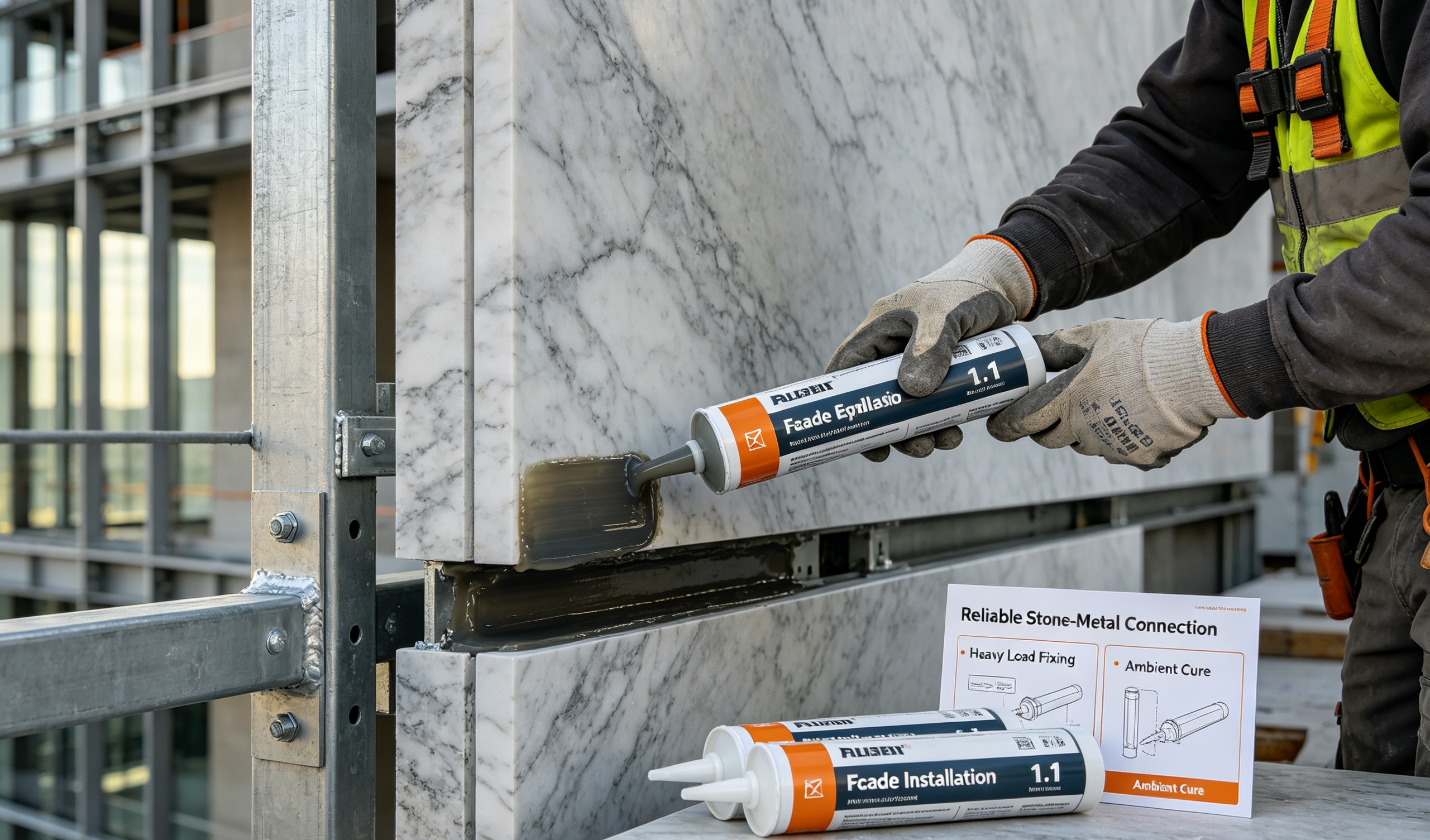
Heavy Load Stone Adhesive Glue: Strongest Form of Epoxy for Stone-Metal Connection
1. Introduction: How Regular Glue Fails in Heavy Load Stone Glue
Heavy load stone adhesive is an effective method of construction when it comes to façade creation of different structures as well as assembling of machinery, making marine engineering constructions, or carrying out building restoration work. All heavy load stone materials are granite, marble, bluestone, and also manufactured stone which have peculiarities such as being porous, and therefore, having low strength properties, as well as a large mass. Heavy load stone materials must frequently gain stability when being glued to metals, such as stainless steel, carbon steel, aluminum alloy, copper, and others.
Commonly used super glues, acrylic glues, and classical one-component glues are not suitable for sustaining heavy loads for a long time, being operated in varied temperatures, and humid saline-alkali surroundings. They can delaminate on interfaces, crack in glue layers and adhesives, and stones get unglued or fall down from surfaces. Hence, heavy load epoxy glue is the best option for stone-metal joining due to its extremely high gluing power, low curing shrinkage, and excellent acclimatization properties.
2. Working Principle of Heavy Load Stone Epoxy Glue
Heavy load stone glue is a solvent-less glue system made up of bisphenol A epoxy resin and modified amine hardener and ensures that modern technology of room temperature crosslinking occurs.The majority of products should be mixed in the ratio of 1:1, which is what renders their application easier and simpler.The resin and the hardener are mixed in a complete manner in a specific ratio after which polymer cross-linking happens at ambient temperature and the mixture is transformed into dense three-dimensional polymer network. It should be noted that this method of curing results in the formation of a dual bonding system, which is a combination of physical anchoring and chemical adhesion methods. In the case of porous stone surfaces, the epoxy adhesive penetrates into the micropores and small cracks creating some mechanical anchoring system which would prevent the stone from falling away from the substrate.
In contrast to smooth and highly dense metal surfaces, the use of active modified components included in the epoxy formula enables to achieve a certain level of chemical adhesion thus filling the micro-gaps in the interface sections of different materials.
Cured epoxy layer is not going to suffer from creeping and deformation processes under the pressure for a long time thus distributing the stress as well as eliminating the risk of creation of local stresses.
3. Key Characteristics of Heavy-Duty Stone Adhesive
Unlike common adhesives, heavy-duty industrial epoxy adhesives provide a number of advantages that are beneficial for their use under load bearing conditions.
3.1. Very High Bonding Strength
The aforementioned heavy-duty epoxy system has good mechanical properties that allow joining of various materials. Shear strength is 8-12 MPa for the joints constructed from stone and stainless steel composite and tensile strength equals to 6-9 MPa.The adhered layer is able to withstand dynamic impacts as well as static loads that are 3-5 times thicker than those resistances of conventional structural adhesives which hold this level. Section 3.2 – Elements of ultra low shrinkage and good dimensional stability
The shrinkage value should be lower than 0.5% while using professional stone adhesive, meaning that there is no risk to have delaminating joints or stone cracking due to shrinkage or cure stresses.
The stone adhesive provides no problem too since this adhesive has the ability to adjust the thermal expansion coefficient of stone and metal base and avoid stress caused by temperature changes. Thus, it is possible to be sure that bonded surfaces will not change their shape and will not separate in the process of time during changing temperature conditions.
Section 3.3 – Properties of high resistance to environmental conditions and environments
Referring to its cross-linked epoxy composition the heavy-duty stone adhesive is resistant to the chemical processes and actions as well as operates in the form of resistance for both acids and bases of the pH range from 3 to 11 as well as for the majority of chemicals of organic reduction. The adhesive has wonderful waterproof characteristics and is also moisture and acid resistant which gives a possibility to use it outdoors or in wet marine conditions. It is able to withstand all extremes of temperature fluctuations, wet environment and aging of ultraviolet rays.
Section 3.4 – Construction uses and environmental friendliness
Heavy-duty adhesive goods are produced based on zero-VOC technologyHarmful substances do not evaporate into atmosphere with their usage and the material is also compliant with the international ecological requirements. Component ratio of the composition is equal to 1:1, so no sophisticated measuring equipment is necessary. Furthermore, it cures under ambient temperature thus avoiding application of high temperature on stone products and metals.
4.1 Selecting the Suitable Substrate
In case of solid and high-density rock materials such as granite and bluestone that are to be matched with carbon steel and stainless steel for heavy severe applications, epoxy adhesives that are resistant to shearing stress and can act as stress buffers should be used in order to prevent cracking of stone material under heavy load. As for the lightweight non-ferrous metals such as copper and aluminum alloys with easily oxidized surface, modified epoxy adhesives intended for lightweight metals should be utilized in order to increase the chemical bond between the oxidized film and the stone thus providing higher stability of interface.
4.2 Selecting by Purpose
In case of construction work and light installation of stone materials, fast curing epoxy adhesive with the time of setting of 5 minutes should be used as it will help in saving time while working. In case of stone construction for buildings and marine constructions or heavy equipment installation the epoxy that shrinks less and4.3 Selecting the Essence of Core Indicators
For the stone adhesive to reflect compliance with formal large load construction requirements, it has to fulfill certain industrial standards.
5. Established Manufacturing Process of Heavy Stone Bonding
The formal heavy stone bonding process comprises the three main steps:
5.1 Surface Pretreatment
The removal of any dust, grease, rust, and oxides from the bonding surfaces of metals and stones is a must. Metal surfaces should be polished so that a certain roughness is achieved and consequently, the future bond is better anchored. Stone surfaces should be cleaned of dust.
5.1 Glue Mixing and Application
Mix the epoxy resin and hardener in the ratios of 1:1. Stir constantly in one direction until the mixture is ready. Apply the glue to the prepared bonding surfaces making sure that the glue layer does not exceed 0.2-0.5 mm.
5.1 Components Introduction and Curing
The stone and metal substrates have to be aligned properly for laminating and pressed at the right amount of force after applying the glue to eliminate any air left.Curing is performed at a temperature between 21 and 27 °C. The Heavy Load Stone Epoxy Adhesive is widely used in various fields in engineering. Among the fields are: Architecture, Construction, Marine Engineering, and Restoration. The following applications in the field of architecture illustrate some of the major uses of heavy load stone adhesive: Through this technology, in the construction sector, heavy load marble and granite decorative elements are fixed, indoor facilities with stone- metal combining products are created.
In the civil engineering and industry sector, mechanical structures with heavy loads are assembled, stone tables and covers are manufactured, steel covers with stone coatings are attached, and so on. Within this technology in the marine industry, stone elements are combined with steel components in ships, wherein both groups of materials must be in direct contact with marine environment as much as possible.
In structural repair, mechanical structures that were not firm enough due to weak bonding are repaired. At this stage, problems of adhesive bonding will be considered. The problem can be explained by inadequate cleanliness of surfaces being

